
Product Information
| MW (kDa) | 13 and 40 |
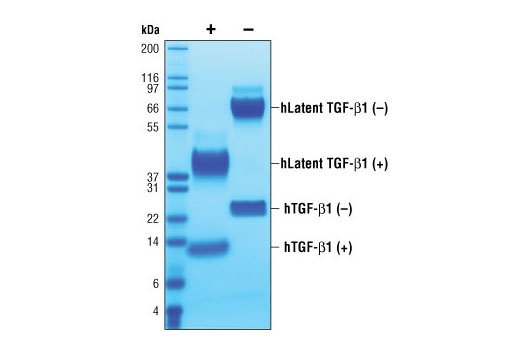
| Purity | >98% as determined by SDS-PAGE of 6 μg reduced (+) and non-reduced (-) recombinant hLatent TGF-β1. All lots are greater than 98% pure. |
| Endotoxin | Less than 0.01 ng endotoxin/1 μg hLatent TGF-β1. |
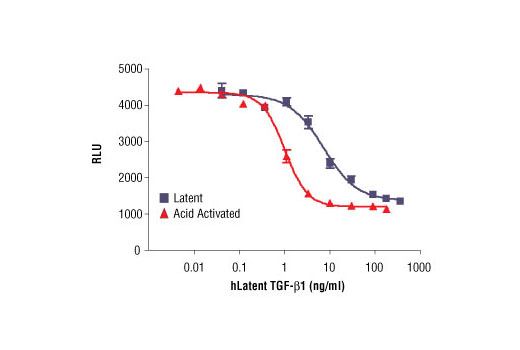
| Activity | The bioactivity of recombinant hLatent TGF-β1 was determined by assessing inhibition of IL-4 induced HT-2 cell proliferation. The ED50 of each lot is between 0.2- 10 ng/ml after acid activation. |
| Molecular Formula | Recombinant hLatent TGF-β1 contains no "tags" and the nonglycosylated small latent TGF-β1 complex has a calculated MW of 41,251. DTT-reduced protein migrates as 40 and 13 kDa polypeptides, and the non-reduced cystine-linked homodimers migrate as 80 and 25 kDa proteins. The expected amino-terminal ALDTN of recombinant hTGF-β1 and the expected amino-terminal LSTSK of recombinant latency-associated peptide (LAP) were verified by amino acid sequencing. |
Recombinant human latent TGF-β1 (hLatent TGF-β1) Leu30-Ser390 (Accession #P01137) was expressed in human 293 cells at Cell Signaling Technology.
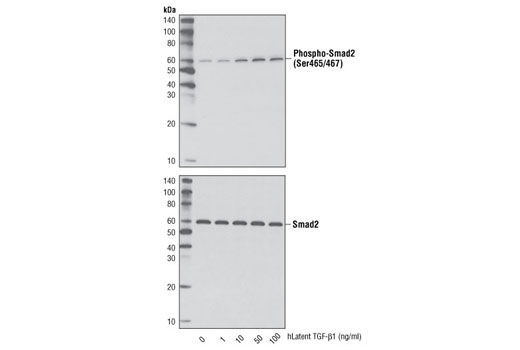
Latent TGF-β1 is a complex of two proteins, latency associated protein (LAP) and TGF-β1, which is derived from cleavage of a common 75 kDa precursor protein (1). The LAP protein spatially and temporally regulates TGF-β1 activity by sequestering TGF-β1 in the extracellular matrix in conjunction with latent TGF-β1 binding proteins (LTBP)(1). The release of TGF-β1 is activated by a number of stimuli including proteases, thrombospondin-1, reactive oxygen species, and some integrins (1). Active TGF-β1 binds to TβRII homodimer, which then complexes with TβRI homodimer (2,3). The oligomeric receptor complex phosphorylates subsets of the Smad proteins that then act to induce or repress a number of target genes (3-5). TGF-β1 binding can also activate the Erk2, p38, and Jnk pathways via TAK1 (5). Active TGF-β1 activities include proliferation, angiogenesis, and promotion or inhibition of many immune events (2,4,5). Latent TGF-β1 is present on the surface of regulatory T cells in association with GARP and may contribute directly to their immunosuppressive activity (6,7).
Explore pathways related to this product.
STRING - Known and Predicted Protein-Protein Interactions.
Except as otherwise expressly agreed in a writing signed by a legally authorized representative of CST, the following terms apply to Products provided by CST, its affiliates or its distributors. Any Customer's terms and conditions that are in addition to, or different from, those contained herein, unless separately accepted in writing by a legally authorized representative of CST, are rejected and are of no force or effect.
Products are labeled with For Research Use Only or a similar labeling statement and have not been approved, cleared, or licensed by the FDA or other regulatory foreign or domestic entity, for any purpose. Customer shall not use any Product for any diagnostic or therapeutic purpose, or otherwise in any manner that conflicts with its labeling statement. Products sold or licensed by CST are provided for Customer as the end-user and solely for research and development uses. Any use of Product for diagnostic, prophylactic or therapeutic purposes, or any purchase of Product for resale (alone or as a component) or other commercial purpose, requires a separate license from CST. Customer shall (a) not sell, license, loan, donate or otherwise transfer or make available any Product to any third party, whether alone or in combination with other materials, or use the Products to manufacture any commercial products, (b) not copy, modify, reverse engineer, decompile, disassemble or otherwise attempt to discover the underlying structure or technology of the Products, or use the Products for the purpose of developing any products or services that would compete with CST products or services, (c) not alter or remove from the Products any trademarks, trade names, logos, patent or copyright notices or markings, (d) use the Products solely in accordance with CST Product Terms of Sale and any applicable documentation, and (e) comply with any license, terms of service or similar agreement with respect to any third party products or services used by Customer in connection with the Products.

 PhosphoSitePlus®