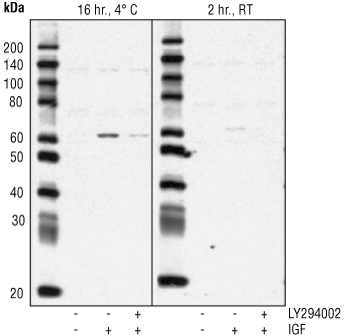
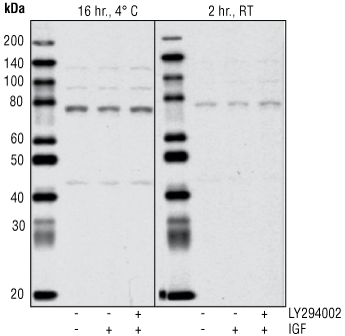
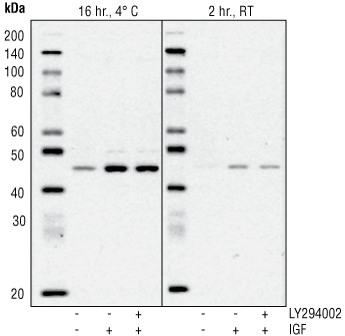
Cell Signaling Technology (CST) antibodies are validated using our recommended western blotting protocol, developed and optimized by CST scientists. All data shown on product webpages and datasheets was generated using these protocols. We strongly recommend following our protocols to achieve optimal results with all of our antibodies. Below are a few examples of the effects minor changes to the standard protocol may have on your results.
Sonication versus no sonication
Phospho-Histone H3 (Ser10) Antibody #9701
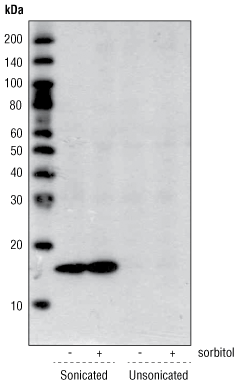
CKR/PAEC cell extracts
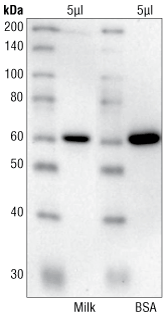
Milk versus BSA
Phospho-Akt (Ser473) Antibody #9271
C2C12 cells + insulin
Overnight at 4°C versus 2 hours at room temperature
TBS-T versus PBS-T
Phospho-c-Jun (Ser63) II Antibody #9261
c-Jun (60A8) Rabbit mAb #9165
Ribosomal Protein S3 Antibody #2579
Calnexin (C5C9) Rabbit mAb #2679
Phospho-4E-BP1 (Thr37/46) (236B4) Rabbit mAb #2855
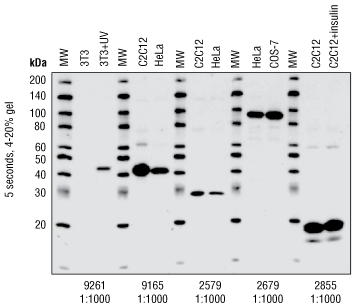
TBS-T (as recommended in CST protocol)
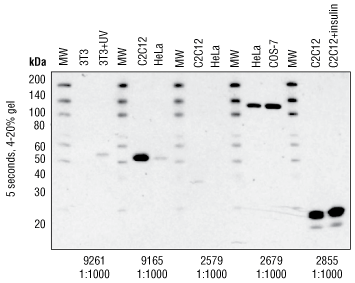
PBS-T (altered protocol)
Cell Signaling Technology recommends wet transfer (as recommended by manufacturer) followed by one hour blocking and overnight primary antibody incubation at 4˚C.
iBlot is a dry blotting system that completes transfer in 7 minutes. SNAPi.d. is a vacuum operated incubation system, which reduces antibody incubation times to less than 30 minutes.
Phospho-p38 MAPK (Thr180/Tyr182) (3D7) Rabbit mAb #9215
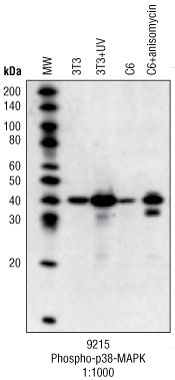
Wet transfer CST recommended incubations
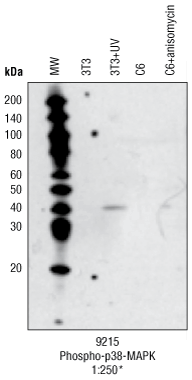
iBlot (quick transfer-Invitrogen) SNAPi.d. (quick incubations-Millipore) * determined optimal antibody concentration for SNAPi.d.