Revision 4
#12117
Store at -20C

877-616-CELL (2355)
877-678-TECH (8324)
3 Trask Lane | Danvers | Massachusetts | 01923 | USA
For Research Use Only. Not for Use in Diagnostic Procedures.
Applications:
W, IP
Reactivity:
H M R
Sensitivity:
Endogenous
MW (kDa):
105
Source/Isotype:
Rabbit IgG
UniProt ID:
#Q96J02
Entrez-Gene Id:
83737
Product Usage Information
| Application | Dilution |
|---|---|
| Western Blotting | 1:1000 |
| Immunoprecipitation | 1:200 |
Storage
Specificity/Sensitivity
Source / Purification
Background
Further characterizations revealed that Itch encoded a NEDD4-like E3-ubiquitin ligase capable of catalyzing Lys29, Lys48, and/or Lys63-linked ubiquitination of target proteins, leading to their degradation by the proteosome pathway (4-6). The distinct phenotypes of Itch mutant mice led to the identification of an important regulatory role for ITCH-mediated ubiquitination in inflammatory signaling pathways. For example, ITCH-mediated ubiquitination of the transcription factor JunB was shown to play a direct inhibitory role in regulating expression of the proinflammatory cytokine IL-4. ITCH-null T lymphocytes consequently exhibit increased production of IL-4, leading to biased differentiation of naive CD4+ cells towards the proinflammatory Th2 lineage (7). In accordance with the findings from mutant Itch mouse models, a genetic linkage study in humans identified loss-of-function mutations in ITCH as a direct cause of syndromic multisystem autoimmune disease (SMAD) (8).
Notably, targets of ITCH-mediated ubiquitination are not restricted to immune signaling pathways. For example, key mediators of the Hedgehog (9,10), Wnt/β-catenin (11), Hippo (12), and Notch signaling pathways (13,14) have been identified as important targets of ITCH-mediated ubiquitination (2).
Background References
- Matesic, L.E. et al. (2008) Curr Top Microbiol Immunol 321, 185-200.
- Melino, G. et al. (2008) Cell Death Differ 15, 1103-12.
- Perry, W.L. et al. (1998) Nat Genet 18, 143-6.
- Chastagner, P. et al. (2006) EMBO Rep 7, 1147-53.
- Lee, T.L. et al. (2008) Biochem Biophys Res Commun 375, 326-30.
- Ahmed, N. et al. (2011) Nat Immunol 12, 1176-83.
- Fang, D. et al. (2002) Nat Immunol 3, 281-7.
- Lohr, N.J. et al. (2010) Am J Hum Genet 86, 447-53.
- Di Marcotullio, L. et al. (2006) Nat Cell Biol 8, 1415-23.
- Di Marcotullio, L. et al. (2011) Oncogene 30, 65-76.
- Wei, W. et al. (2012) Mol Cell Biol 32, 3903-12.
- Salah, Z. et al. (2011) Cancer Res 71, 2010-20.
- Qiu, L. et al. (2000) J Biol Chem 275, 35734-7.
- McGill, M.A. and McGlade, C.J. (2003) J Biol Chem 278, 23196-203.
Species Reactivity
Species reactivity is determined by testing in at least one approved application (e.g., western blot).
Western Blot Buffer
IMPORTANT: For western blots, incubate membrane with diluted primary antibody in 5% w/v nonfat dry milk, 1X TBS, 0.1% Tween® 20 at 4°C with gentle shaking, overnight.
Applications Key
W: Western Blotting IP: Immunoprecipitation
Cross-Reactivity Key
H: Human M: Mouse R: Rat
Trademarks and Patents
Cell Signaling Technology is a trademark of Cell Signaling Technology, Inc.
All other trademarks are the property of their respective owners. Visit cellsignal.com/trademarks for more information.
Limited Uses
Limited Uses
Except as otherwise expressly agreed in a writing signed by a legally authorized representative of CST, the following terms apply to Products provided by CST, its affiliates or its distributors. Any Customer's terms and conditions that are in addition to, or different from, those contained herein, unless separately accepted in writing by a legally authorized representative of CST, are rejected and are of no force or effect.
Products are labeled with For Research Use Only or a similar labeling statement and have not been approved, cleared, or licensed by the FDA or other regulatory foreign or domestic entity, for any purpose. Customer shall not use any Product for any diagnostic or therapeutic purpose, or otherwise in any manner that conflicts with its labeling statement. Products sold or licensed by CST are provided for Customer as the end-user and solely for research and development uses. Any use of Product for diagnostic, prophylactic or therapeutic purposes, or any purchase of Product for resale (alone or as a component) or other commercial purpose, requires a separate license from CST. Customer shall (a) not sell, license, loan, donate or otherwise transfer or make available any Product to any third party, whether alone or in combination with other materials, or use the Products to manufacture any commercial products, (b) not copy, modify, reverse engineer, decompile, disassemble or otherwise attempt to discover the underlying structure or technology of the Products, or use the Products for the purpose of developing any products or services that would compete with CST products or services, (c) not alter or remove from the Products any trademarks, trade names, logos, patent or copyright notices or markings, (d) use the Products solely in accordance with CST Product Terms of Sale and any applicable documentation, and (e) comply with any license, terms of service or similar agreement with respect to any third party products or services used by Customer in connection with the Products.
Revision 4
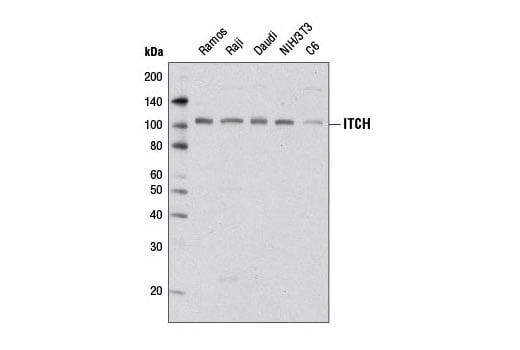
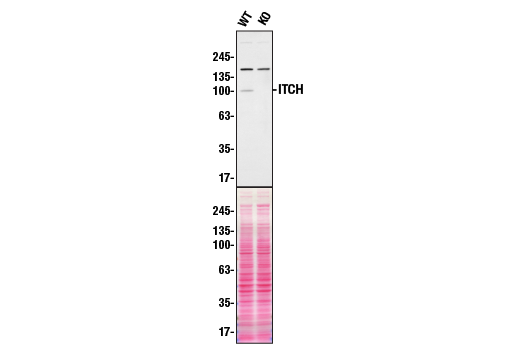
for total protein normalization (lower). These data were provided by
YCharOS Inc., an open science company with the mission of characterizing
commercially available antibodies, as a companion to validation data generated
by CST scientists.