Revision 3

#25940

Store at -20C

CST Logo
Orders:

877-616-CELL (2355)

[email protected]

Support:

877-678-TECH (8324)

3 Trask Lane | Danvers | Massachusetts | 01923 | USA

For Research Use Only. Not for Use in Diagnostic Procedures.

Applications:
W, W-S, ChIP

Reactivity:
H

Sensitivity:
Endogenous

MW (kDa):
60-65, 124

Source/Isotype:
Rabbit IgG

UniProt ID:
#Q12772

Entrez-Gene Id:
6721

Product Usage Information

For optimal ChIP results, use 2.5 μL of antibody and 10 μg of chromatin (approximately 4 × 10⁶ cells) per IP. This antibody has been validated using SimpleChIP® Enzymatic Chromatin IP Kits.
Application Dilution
Western Blotting 1:1000
Simple Western™ 1:10 - 1:50
Chromatin IP 1:200

Storage

Supplied in 10 mM sodium HEPES (pH 7.5), 150 mM NaCl, 100 µg/mL BSA, 50% glycerol, and less than 0.02% sodium azide. Store at –20°C. Do not aliquot the antibody.

Specificity/Sensitivity

SREBP-2 (F1X2D) Rabbit Monoclonal Antibody recognizes endogenous levels of total SREBP-2 protein. This antibody does not cross-react with SREBP-1 protein.

Source / Purification

Monoclonal antibody is produced by immunizing animals with a synthetic peptide corresponding to residues surrounding Gly40 of human SREBP-2 protein.

Background

Sterol regulatory element–binding proteins (SREBPs) are basic-helix-loop-helix–leucine zipper (bHLH-Zip) transcription factors. Inactive precursor forms of SREBPs are bound to endoplasmic reticulum (ER) membranes. When cells are starved for sterols, SREBPs move from the ER to the Golgi apparatus with the help of SREBP cleavage activating protein (SCAP). In the Golgi apparatus, precursor SREBPs are then sequentially cleaved by two proteases, site-1 protease (S1P) and site-2 protease (S2P). The released N-terminal domain that contains the bHLH-Zip region enters the nucleus and binds to sterol response elements (SREs) in the promoters of a variety of genes responsible for the synthesis of cholesterol, fatty acids, and other lipids, activating their expressions (1,2). Studies show that, in the tumor microenvironment, sterol metabolites oxysterols change the activities of SREBP-2 and LXR pathways and, therefore, cause T cell cholesterol deficiency, leading to T cell exhaustion and dysfunction (3). In addition, cholesin, a hormone secreted from the intestine as a reaction to cholesterol absorption, inhibits SREBP-2-mediated cholesterol production in the liver (4).

Species Reactivity

Species reactivity is determined by testing in at least one approved application (e.g., western blot).

Western Blot Buffer

IMPORTANT: For western blots, incubate membrane with diluted primary antibody in 5% w/v nonfat dry milk, 1X TBS, 0.1% Tween® 20 at 4°C with gentle shaking, overnight.

Applications Key

W: Western Blotting W-S: Simple Western™ ChIP: Chromatin IP

Cross-Reactivity Key

H: Human

Trademarks and Patents

Cell Signaling Technology is a trademark of Cell Signaling Technology, Inc.

All other trademarks are the property of their respective owners. Visit cellsignal.com/trademarks for more information.

Limited Uses

Except as otherwise expressly agreed in a writing signed by a legally authorized representative of CST, the following terms apply to Products provided by CST, its affiliates or its distributors. Any Customer's terms and conditions that are in addition to, or different from, those contained herein, unless separately accepted in writing by a legally authorized representative of CST, are rejected and are of no force or effect.

Products are labeled with For Research Use Only or a similar labeling statement and have not been approved, cleared, or licensed by the FDA or other regulatory foreign or domestic entity, for any purpose. Customer shall not use any Product for any diagnostic or therapeutic purpose, or otherwise in any manner that conflicts with its labeling statement. Products sold or licensed by CST are provided for Customer as the end-user and solely for research and development uses. Any use of Product for diagnostic, prophylactic or therapeutic purposes, or any purchase of Product for resale (alone or as a component) or other commercial purpose, requires a separate license from CST. Customer shall (a) not sell, license, loan, donate or otherwise transfer or make available any Product to any third party, whether alone or in combination with other materials, or use the Products to manufacture any commercial products, (b) not copy, modify, reverse engineer, decompile, disassemble or otherwise attempt to discover the underlying structure or technology of the Products, or use the Products for the purpose of developing any products or services that would compete with CST products or services, (c) not alter or remove from the Products any trademarks, trade names, logos, patent or copyright notices or markings, (d) use the Products solely in accordance with CST Product Terms of Sale and any applicable documentation, and (e) comply with any license, terms of service or similar agreement with respect to any third party products or services used by Customer in connection with the Products.

Orders: 877-616-CELL (2355) [email protected] Support: 877-678-TECH (8324) [email protected] Web: cellsignal.com
For Research Use Only. Not for Use in Diagnostic Procedures.

Revision 3

Cell Signaling Technology Logo
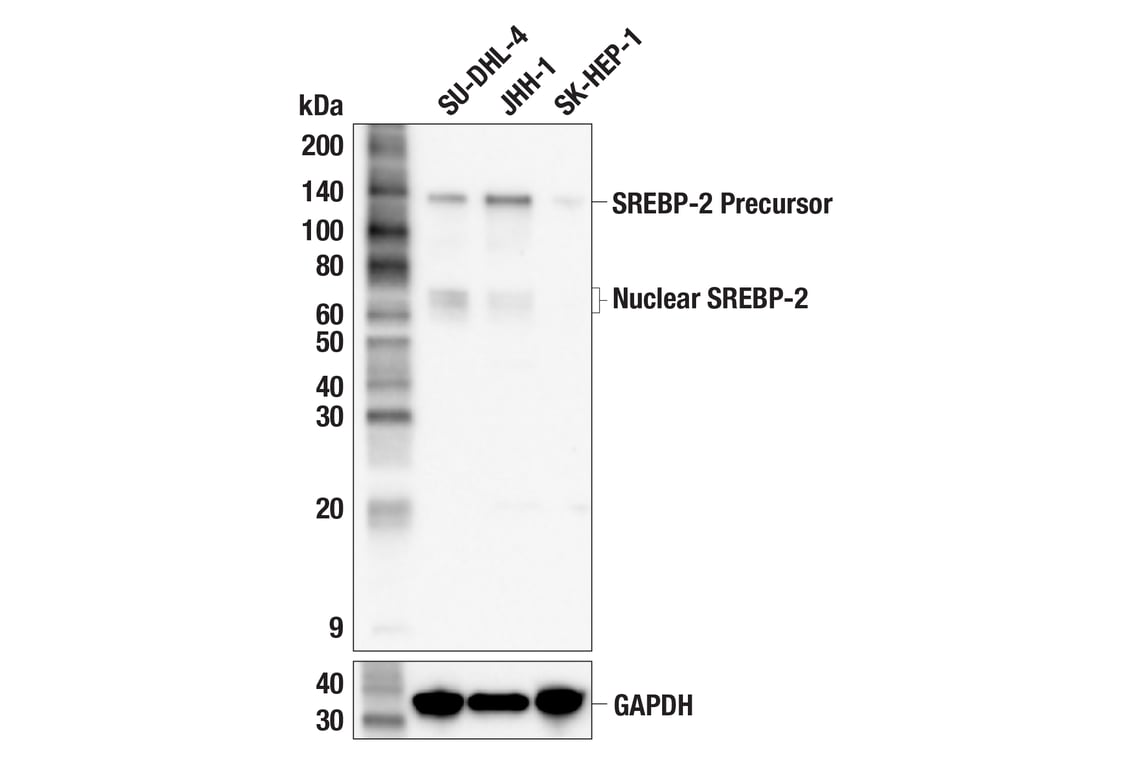
Western blot analysis of extracts from SU-DHL-4, JHH-1, and SK-HEP-1 cells using SREBP-2 (F1X2D) Rabbit mAb (upper) or GAPDH (D16H11) XP® Rabbit mAb #5174 (lower). Low expression of SREBP-2 protein in SK-HEP-1 cells is consistent with the predicted expression pattern.
Western Blotting Image 1: SREBP-2 (F1X2D) Rabbit Monoclonal Antibody
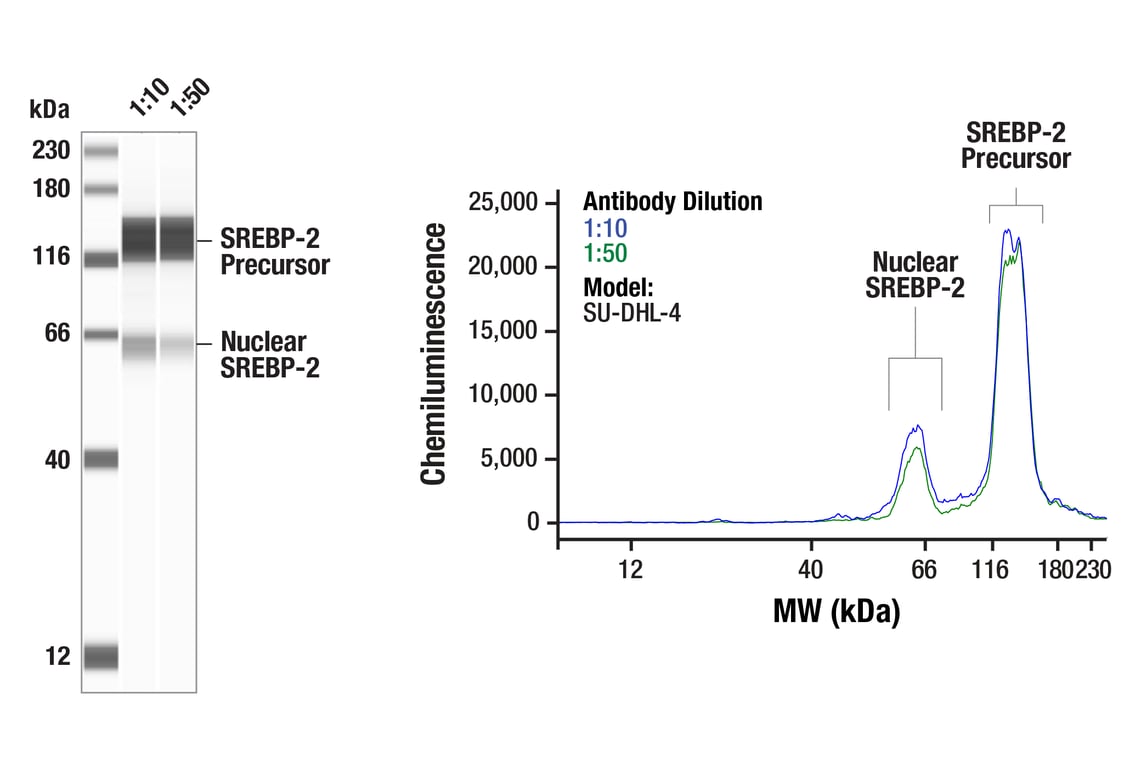
Simple WesternTM analysis of lysates (1.0 mg/mL) from SU-DHL-4 cells using SREBP-2 (F1X2D) Rabbit mAb #25940. The virtual lane view (left) shows the target bands (as indicated) at 1:10 and 1:50 dilutions of primary antibody. The corresponding electropherogram view (right) plots chemiluminescence by molecular weight along the capillary at 1:10 (blue line) and 1:50 (green line) dilutions of primary antibody. This experiment was performed under reducing conditions on the JessTM Simple Western instrument from ProteinSimple, a BioTechne brand, using the 12-230 kDa separation module.
Western Blotting Image 1: SREBP-2 (F1X2D) Rabbit Monoclonal Antibody
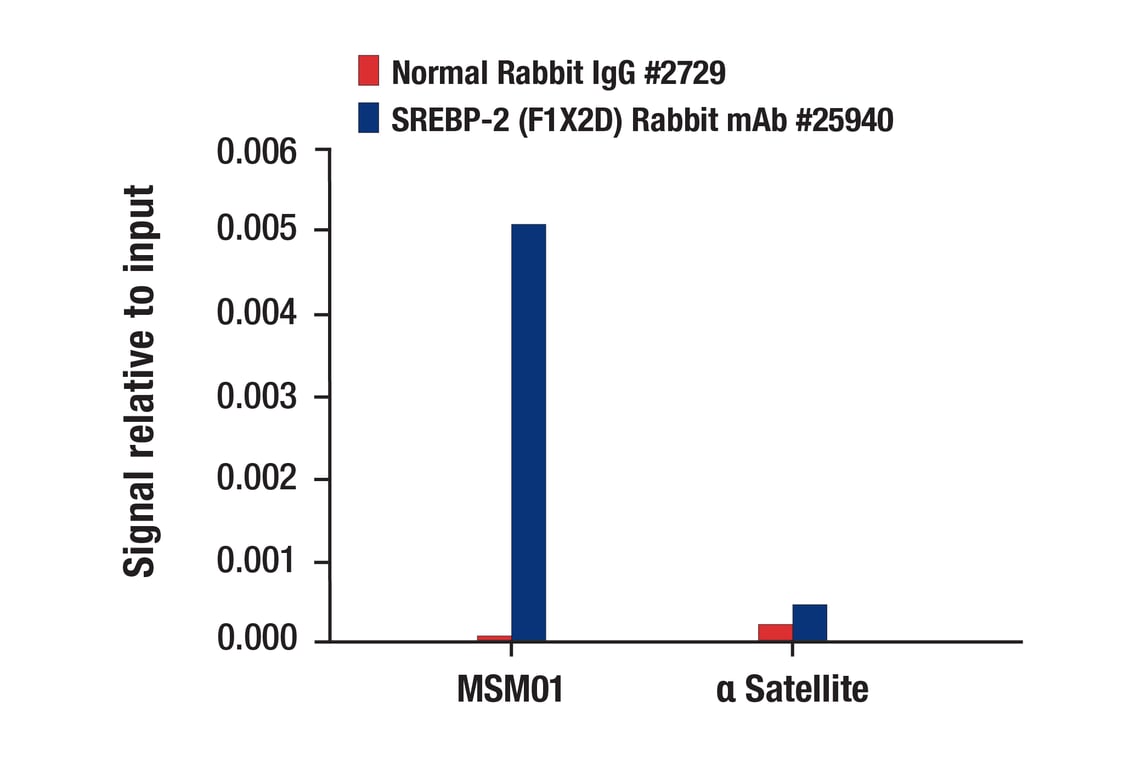
Chromatin immunoprecipitations were performed with cross-linked chromatin from JHH-1 cells and either SREBP-2 (F1X2D) Rabbit mAb or Normal Rabbit IgG #2729, using SimpleChIP® Plus Enzymatic Chromatin IP Kit (Magnetic Beads) #9005. The enriched DNA was quantified by real-time PCR, using human MSMO1 promoter primers and SimpleChIP® Human α Satellite Repeat Primers #4486. The amount of immunoprecipitated DNA in each sample is represented as signal relative to the total amount of input chromatin, which is equivalent to one.
Chromatin Immunoprecipitation Image 1: SREBP-2 (F1X2D) Rabbit Monoclonal Antibody
Orders: 877-616-CELL (2355) [email protected] Support: 877-678-TECH (8324) [email protected] Web: cellsignal.com
For Research Use Only. Not for Use in Diagnostic Procedures.