Revision 3

#50830

Store at -20C

CST Logo
Orders:

877-616-CELL (2355)

[email protected]

Support:

877-678-TECH (8324)

3 Trask Lane | Danvers | Massachusetts | 01923 | USA

For Research Use Only. Not for Use in Diagnostic Procedures.

Applications:
W, IP, ChIP

Reactivity:
H

Sensitivity:
Endogenous

MW (kDa):
29

Source/Isotype:
Rabbit IgG

UniProt ID:
#P28069

Entrez-Gene Id:
5449

Product Usage Information

For optimal ChIP, use 2.5 μl of antibody and 10 μg of chromatin (approximately 4 x 10⁶ cells) per IP. This antibody has been validated using SimpleChIP® Enzymatic Chromatin IP Kits.
Application Dilution
Western Blotting 1:1000
Immunoprecipitation 1:50
Chromatin IP 1:200

Storage

Supplied in 10 mM sodium HEPES (pH 7.5), 150 mM NaCl, 100 µg/mL BSA, 50% glycerol, and less than 0.02% sodium azide. Store at –20°C. Do not aliquot the antibody.

Specificity/Sensitivity

GHF-1 (F9C3D) Rabbit Monoclonal Antibody recognizes endogenous levels of total GHF-1 protein.

Source / Purification

Monoclonal antibody is produced by immunizing animals with a synthetic peptide corresponding to residues surrounding Leu86 of human GHF-1 protein.

Background

Growth hormone factor 1 (GHF-1), also known as Pit-1, is a POU domain transcription factor essential for the development and function of specific anterior pituitary cells (i.e., somatotrophs, lactotrophs, and thyrotrophs) (2). It activates the genes for growth hormone, prolactin, and TSH beta, crucial for hormone production and pituitary cell lineage determination (1,2). Mutations in POU1F1 (the gene encoding GHF-1) are a major cause of combined pituitary hormone deficiency and isolated growth hormone deficiency, leading to impaired hormone secretion and developmental issues (3). While GHF-1 is crucial for normal pituitary development, its role in pituitary tumorigenesis is complex and not fully elucidated. Some pituitary adenomas, particularly those of the somatotroph and lactotroph lineages, express GHF-1. However, POU1F1 mutations are not a common cause of sporadic pituitary adenomas. Aberrant GHF-1 expression or activity might contribute to tumor progression in some cases, but further research is needed (4,5).

Species Reactivity

Species reactivity is determined by testing in at least one approved application (e.g., western blot).

Western Blot Buffer

IMPORTANT: For western blots, incubate membrane with diluted primary antibody in 5% w/v BSA, 1X TBS, 0.1% Tween® 20 at 4°C with gentle shaking, overnight.

Applications Key

W: Western Blotting IP: Immunoprecipitation ChIP: Chromatin IP

Cross-Reactivity Key

H: Human

Trademarks and Patents

Cell Signaling Technology is a trademark of Cell Signaling Technology, Inc.

All other trademarks are the property of their respective owners. Visit cellsignal.com/trademarks for more information.

Limited Uses

Except as otherwise expressly agreed in a writing signed by a legally authorized representative of CST, the following terms apply to Products provided by CST, its affiliates or its distributors. Any Customer's terms and conditions that are in addition to, or different from, those contained herein, unless separately accepted in writing by a legally authorized representative of CST, are rejected and are of no force or effect.

Products are labeled with For Research Use Only or a similar labeling statement and have not been approved, cleared, or licensed by the FDA or other regulatory foreign or domestic entity, for any purpose. Customer shall not use any Product for any diagnostic or therapeutic purpose, or otherwise in any manner that conflicts with its labeling statement. Products sold or licensed by CST are provided for Customer as the end-user and solely for research and development uses. Any use of Product for diagnostic, prophylactic or therapeutic purposes, or any purchase of Product for resale (alone or as a component) or other commercial purpose, requires a separate license from CST. Customer shall (a) not sell, license, loan, donate or otherwise transfer or make available any Product to any third party, whether alone or in combination with other materials, or use the Products to manufacture any commercial products, (b) not copy, modify, reverse engineer, decompile, disassemble or otherwise attempt to discover the underlying structure or technology of the Products, or use the Products for the purpose of developing any products or services that would compete with CST products or services, (c) not alter or remove from the Products any trademarks, trade names, logos, patent or copyright notices or markings, (d) use the Products solely in accordance with CST Product Terms of Sale and any applicable documentation, and (e) comply with any license, terms of service or similar agreement with respect to any third party products or services used by Customer in connection with the Products.

Orders: 877-616-CELL (2355) [email protected] Support: 877-678-TECH (8324) [email protected] Web: cellsignal.com
For Research Use Only. Not for Use in Diagnostic Procedures.

Revision 3

Cell Signaling Technology Logo
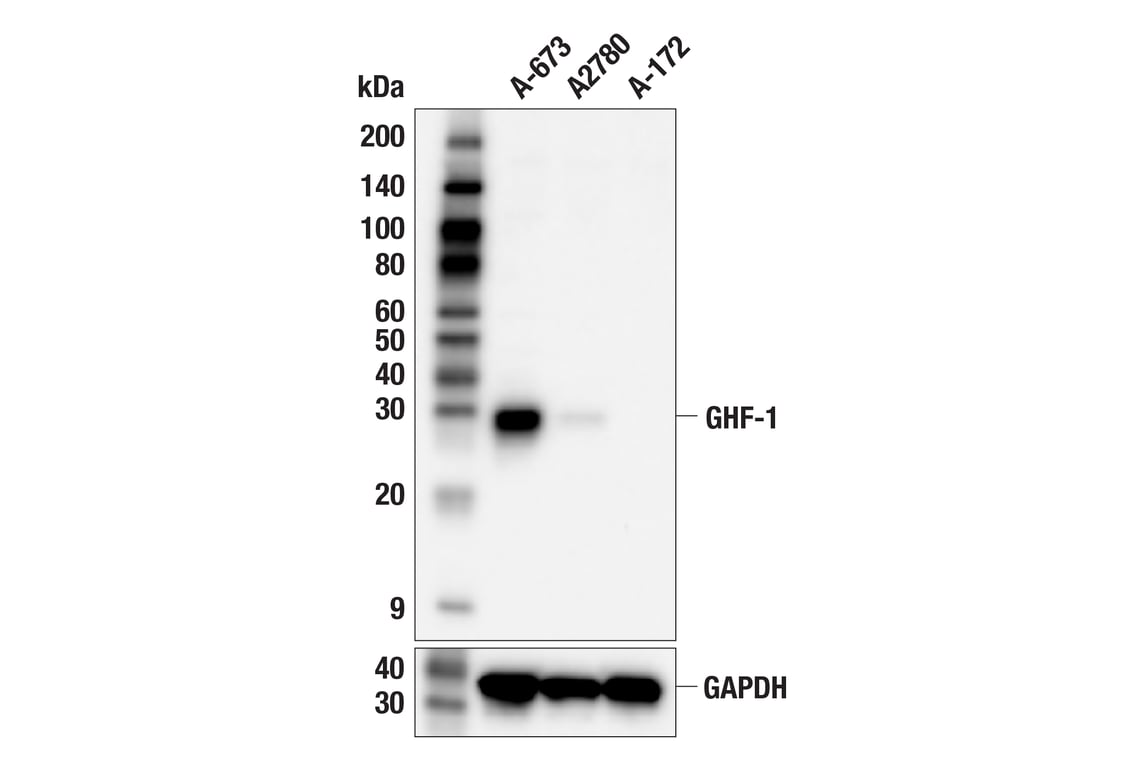
Western blot analysis of extracts from A-673, A2780, and A-172 cells using GHF-1 (F9C3D) Rabbit Monoclonal Antibody (upper) or GAPDH (D16H11) Rabbit Monoclonal Antibody #5174 (lower). Low expression of GHF-1 protein in A2780 cells and negative expression in A-172 cells is consistent with the predicted expression pattern.
Western Blotting Image 1: GHF-1 (F9C3D) Rabbit Monoclonal Antibody
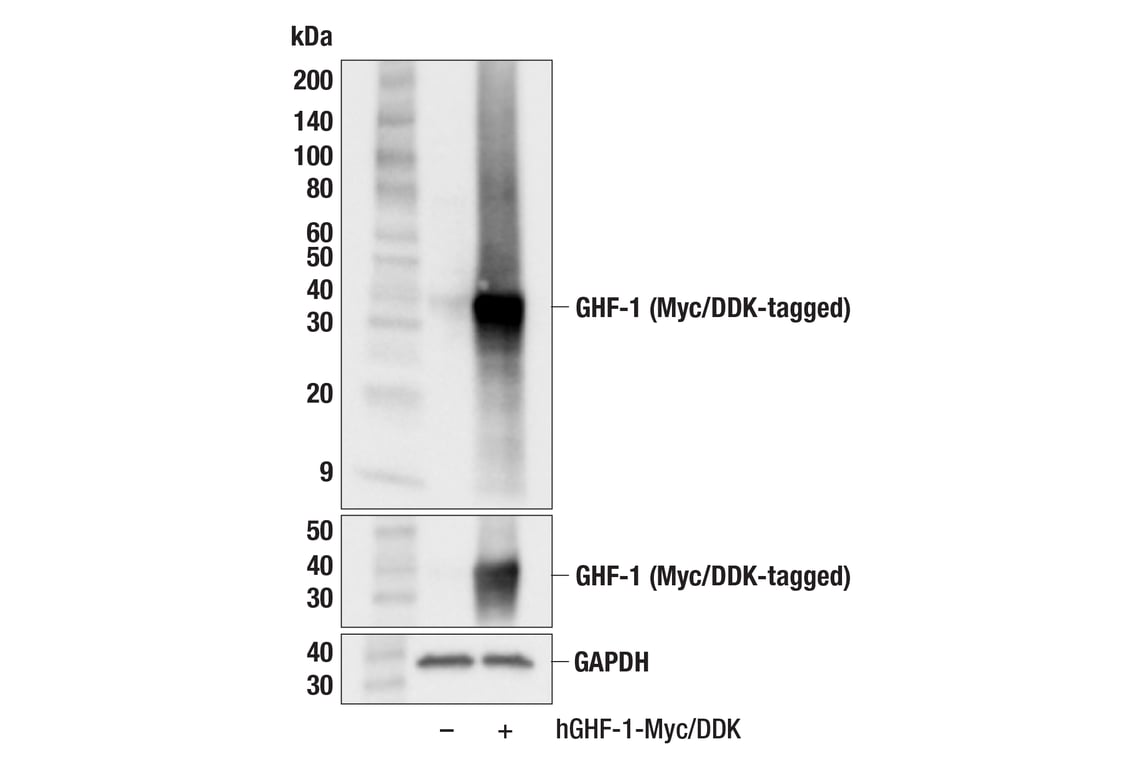
Western blot analysis of extracts from 293T cells, mock transfected (-) or transfected with a construct expressing Myc/DDK-tagged full-length human GHF-1 (hGHF-1-Myc/DDK; +), using GHF-1 (F9C3D) Rabbit Monoclonal Antibody (upper), DYKDDDDK Tag (D6W5B) Rabbit Monoclonal Antibody #14793 (middle), or GAPDH (D16H11) Rabbit Monoclonal Antibody #5174 (lower).
Western Blotting Image 2: GHF-1 (F9C3D) Rabbit Monoclonal Antibody
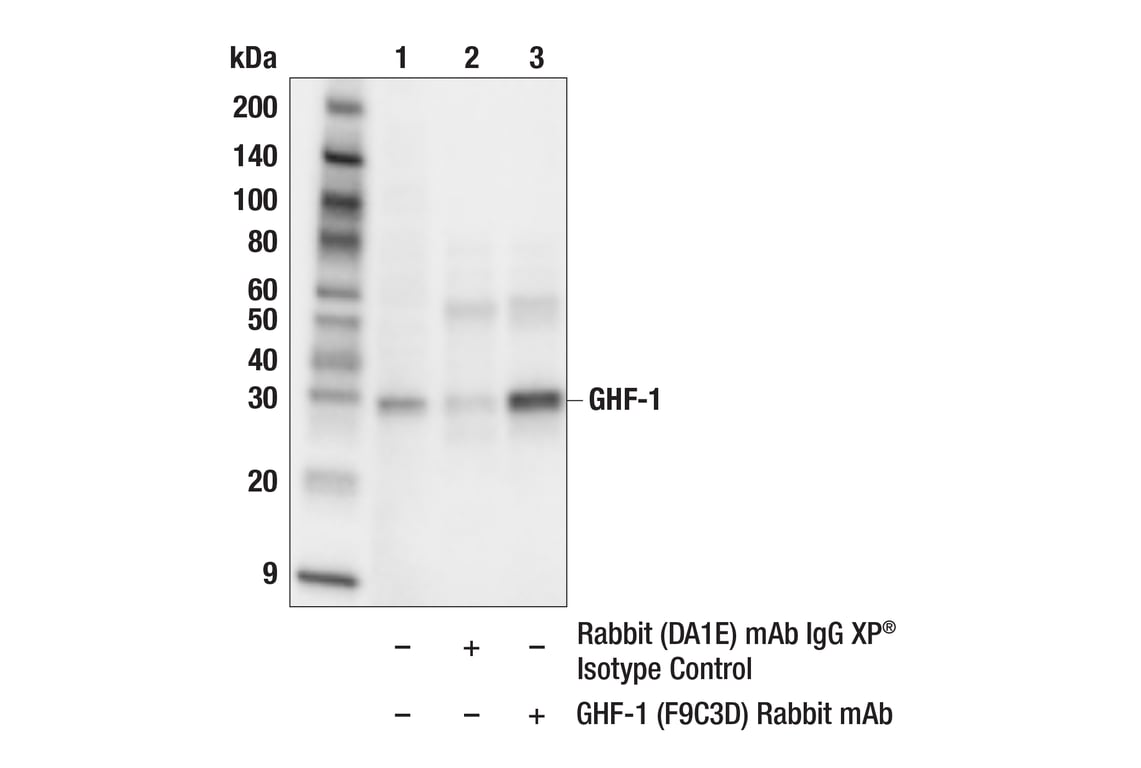
Immunoprecipitation of GHF-1 protein from A-673 cell extracts. Lane 1 is 10% input, lane 2 is Rabbit (DA1E) Monoclonal Antibody IgG Isotype Control #3900, and lane 3 is GHF-1 (F9C3D) Rabbit Monoclonal Antibody. Western blot analysis was performed using GHF-1 (F9C3D) Rabbit Monoclonal Antibody. Mouse Anti-rabbit IgG (Conformation Specific) (L27A9) Monoclonal Antibody (HRP Conjugate) #5127 was used as a secondary antibody.
Immunoprecipitation Image 1: GHF-1 (F9C3D) Rabbit Monoclonal Antibody
Orders: 877-616-CELL (2355) [email protected] Support: 877-678-TECH (8324) [email protected] Web: cellsignal.com
For Research Use Only. Not for Use in Diagnostic Procedures.

Revision 3

Cell Signaling Technology Logo
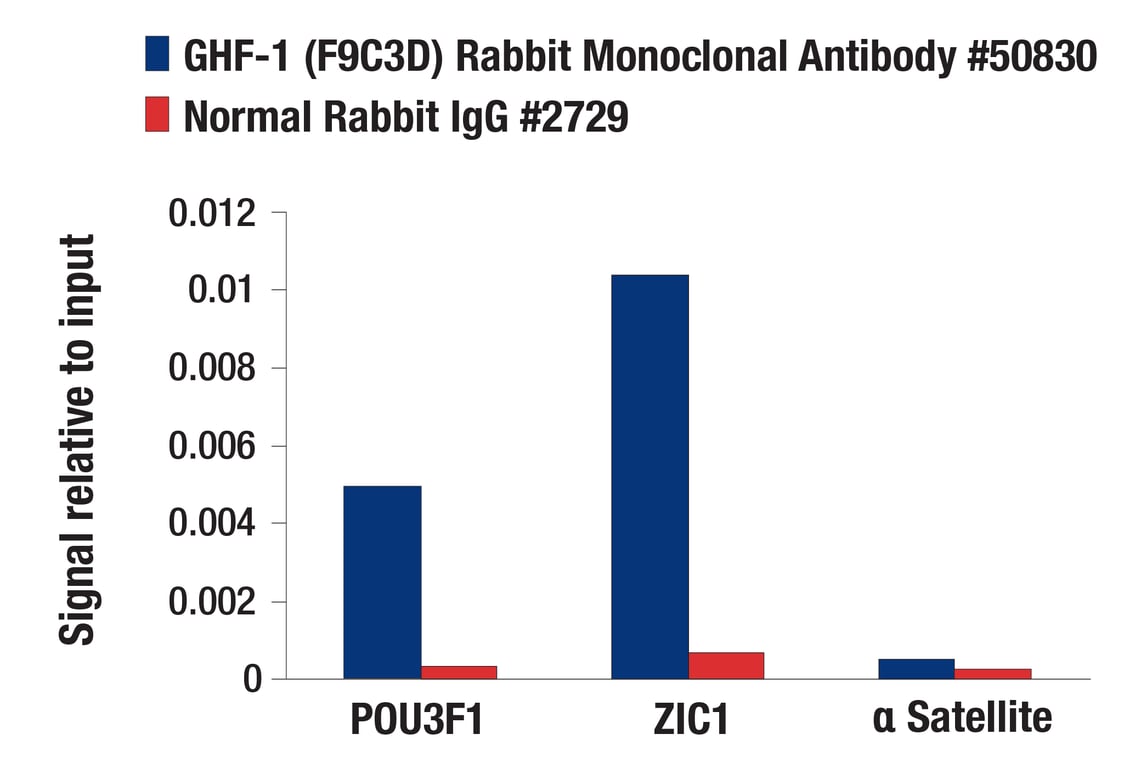
Chromatin immunoprecipitations were performed with cross-linked chromatin from A-673 cells and either GHF-1 (F9C3D) Rabbit Monoclonal Antibody or Normal Rabbit IgG #2729, using SimpleChIP® Plus Enzymatic Chromatin IP Kit (Magnetic Beads) #9005. The enriched DNA was quantified by real-time PCR, using human POU3F1 promoter primers, human ZIC1 downstream primers, and SimpleChIP® Human α Satellite Repeat Primers #4486. The amount of immunoprecipitated DNA in each sample is represented as signal relative to the total amount of input chromatin, which is equivalent to one.
Chromatin Immunoprecipitation Image 1: GHF-1 (F9C3D) Rabbit Monoclonal Antibody
Orders: 877-616-CELL (2355) [email protected] Support: 877-678-TECH (8324) [email protected] Web: cellsignal.com
For Research Use Only. Not for Use in Diagnostic Procedures.