Revision 8
#5726
Store at -20C

877-616-CELL (2355)
877-678-TECH (8324)
3 Trask Lane | Danvers | Massachusetts | 01923 | USA
For Research Use Only. Not for Use in Diagnostic Procedures.
Applications:
W, IF-IC, FC-FP
Reactivity:
H M R Mk
Sensitivity:
Endogenous
MW (kDa):
42, 44
Source/Isotype:
Mouse IgG2a
UniProt ID:
#P27361, #P28482
Entrez-Gene Id:
5595, 5594
Product Usage Information
| Application | Dilution |
|---|---|
| Western Blotting | 1:1000 |
| Immunofluorescence (Immunocytochemistry) | 1:200 |
| Flow Cytometry (Fixed/Permeabilized) | 1:400 - 1:1600 |
Storage
For a carrier free (BSA and azide free) version of this product see product #89967.
Specificity/Sensitivity
Species predicted to react based on 100% sequence homology
Source / Purification
Background
The "activation loop" of MAPK family members contains two phosphorylation sites, typically a threonine and a tyrosine separated by a single amino acid, designated the T-x-Y motif. Phosphorylation on both residues has been shown to be required for full activation of kinase activity, but it has been appreciated for some time that mono-phosphorylation of the T-x-Y motif occurs, resulting in partial activation of catalytic acitvity and priming for subsequent, dual-phosphorylation (11,12). The crystal structures of non-, mono-, and dual-phospho MAPK/Erk demonstrate that each phospho-isomer assumes an independent conformation (13). In addition, mono-phosphorylation of MAPK/Erk2 at Tyr187 reveals that phosphorylation at this site serves to configure the ATP binding site, while phosphorylation of both Tyr and Thr residues is required to completely stabilize the substrate binding site (14). Furthermore, T-x-Y mutational analysis of members of the Erk and p38 MAP kinases appears to suggest that mono-phosphorylation of the T-x-Y motif confers differential activity and substrate preference (15,16). Taken together, these data suggest an important and underappreciated role for Thr- and Tyr- mono-phosphorylation of the T-x-Y motif among MAP kinases.
Background References
- Roux, P.P. and Blenis, J. (2004) Microbiol Mol Biol Rev 68, 320-44.
- Baccarini, M. (2005) FEBS Lett 579, 3271-7.
- Meloche, S. and Pouysségur, J. (2007) Oncogene 26, 3227-39.
- Roberts, P.J. and Der, C.J. (2007) Oncogene 26, 3291-310.
- Rubinfeld, H. and Seger, R. (2005) Mol Biotechnol 31, 151-74.
- Murphy, L.O. and Blenis, J. (2006) Trends Biochem Sci 31, 268-75.
- Dalby, K.N. et al. (1998) J Biol Chem 273, 1496-505.
- Marais, R. et al. (1993) Cell 73, 381-93.
- Kortenjann, M. et al. (1994) Mol Cell Biol 14, 4815-24.
- Owens, D.M. and Keyse, S.M. (2007) Oncogene 26, 3203-13.
- Seger, R. et al. (1991) Proc Natl Acad Sci U S A 88, 6142-6.
- Robbins, D.J. et al. (1993) J Biol Chem 268, 5097-106.
- Kinoshita, T. et al. (2008) Biochem Biophys Res Commun 377, 1123-7.
- Prowse, C.N. et al. (2001) J Biol Chem 276, 40817-23.
- Zhou, B. and Zhang, Z.Y. (2002) J Biol Chem 277, 13889-99.
- Zhang, Y.Y. et al. (2008) J Biol Chem 283, 26591-601.
Species Reactivity
Species reactivity is determined by testing in at least one approved application (e.g., western blot).
Western Blot Buffer
IMPORTANT: For western blots, incubate membrane with diluted primary antibody in 5% w/v nonfat dry milk, 1X TBS, 0.1% Tween® 20 at 4°C with gentle shaking, overnight.
Applications Key
W: Western Blotting IF-IC: Immunofluorescence (Immunocytochemistry) FC-FP: Flow Cytometry (Fixed/Permeabilized)
Cross-Reactivity Key
H: Human M: Mouse R: Rat Mk: Monkey
Trademarks and Patents
Cell Signaling Technology is a trademark of Cell Signaling Technology, Inc.
Alexa Fluor is a registered trademark of Life Technologies Corporation.
All other trademarks are the property of their respective owners. Visit cellsignal.com/trademarks for more information.
Limited Uses
Limited Uses
Except as otherwise expressly agreed in a writing signed by a legally authorized representative of CST, the following terms apply to Products provided by CST, its affiliates or its distributors. Any Customer's terms and conditions that are in addition to, or different from, those contained herein, unless separately accepted in writing by a legally authorized representative of CST, are rejected and are of no force or effect.
Products are labeled with For Research Use Only or a similar labeling statement and have not been approved, cleared, or licensed by the FDA or other regulatory foreign or domestic entity, for any purpose. Customer shall not use any Product for any diagnostic or therapeutic purpose, or otherwise in any manner that conflicts with its labeling statement. Products sold or licensed by CST are provided for Customer as the end-user and solely for research and development uses. Any use of Product for diagnostic, prophylactic or therapeutic purposes, or any purchase of Product for resale (alone or as a component) or other commercial purpose, requires a separate license from CST. Customer shall (a) not sell, license, loan, donate or otherwise transfer or make available any Product to any third party, whether alone or in combination with other materials, or use the Products to manufacture any commercial products, (b) not copy, modify, reverse engineer, decompile, disassemble or otherwise attempt to discover the underlying structure or technology of the Products, or use the Products for the purpose of developing any products or services that would compete with CST products or services, (c) not alter or remove from the Products any trademarks, trade names, logos, patent or copyright notices or markings, (d) use the Products solely in accordance with CST Product Terms of Sale and any applicable documentation, and (e) comply with any license, terms of service or similar agreement with respect to any third party products or services used by Customer in connection with the Products.
Revision 8
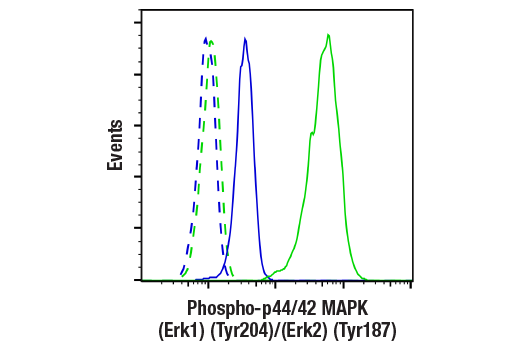
Flow cytometric analysis of Jurkat cells, treated with U0126 #9903 (10 µM, 2 hr; blue) or treated with TPA (12-O-Tetradecanoylphorbol-13-Acetate #4174 (200 nM, 30 min; green) using Phospho-p44/42 MAPK (Erk1) (Tyr204)/(Erk2) (Tyr187) (D1H6G) Mouse mAb (solid lines) or concentration-matched Mouse (G3A1) mAb IgG1 Isotype Control #5415 (dashed lines). Anti-mouse IgG (H+L), F(ab')2 Fragment (Alexa Fluor® 488 Conjugate) #4408 was used as a secondary antibody.