Revision 3
#8496
Store at -20C

877-616-CELL (2355)
877-678-TECH (8324)
3 Trask Lane | Danvers | Massachusetts | 01923 | USA
For Research Use Only. Not for Use in Diagnostic Procedures.
Applications:
W
Reactivity:
R
Sensitivity:
Endogenous
MW (kDa):
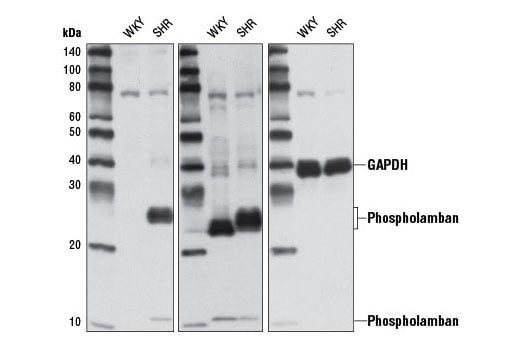
6 (monomer); 12, 24 (oligomers)
Source/Isotype:
Rabbit
UniProt ID:
#P26678
Entrez-Gene Id:
5350
Product Usage Information
| Application | Dilution |
|---|---|
| Western Blotting | 1:1000 |
Storage
Specificity/Sensitivity
Species predicted to react based on 100% sequence homology
Source / Purification
Background
Rodent models of heart failure have shown that the expression level and degree of phosphorylation of PLN are critical in modulating calcium flux and contractility (reviewed in 9-11). Deletion or decreased expression of PLN promotes increased calcium flux and increased cardiac contractility, whereas overexpression of PLN results in sequestration of SERCA, decreased calcium flux, reduced contractility, and rescue of cardiac dysfunction and failure in mouse models of hypertension and cardiomyopathy (reviewed in 10). Distinct mutations in PLN have been detected in humans, resulting either in decreased or no expression of PLN protein (12,13) or binding defects between PLN, SERCA and/or regulatory proteins (14,15), both of which result in cardiac myopathy and heart failure. Interestingly, while the human phenotype of most PLN defects mimic those seen in rodent and vice versa, there are some instances where the type and severity of cardiac disease resulting from PLN mutations in rodent and human differ, making a consensus mechanism elusive.
Background References
- Kirchberber, M.A. et al. (1975) Recent Adv Stud Cardiac Struct Metab 5, 103-15.
- Zhan, Q.Q. et al. (1991) J Biol Chem 266, 21810-4.
- Fujii, J. et al. (1991) J Biol Chem 266, 11669-75.
- Tada, M. and Kirchberger, M.A. Recent Adv Stud Cardiac Struct Metab 11, 265-72.
- Traaseth, N.J. et al. (2008) Biochemistry 47, 3-13.
- Bhupathy, P. et al. (2007) J Mol Cell Cardiol 42, 903-11.
- Hagemann, D. and Xiao, R.P. (2002) Trends Cardiovasc Med 12, 51-6.
- Mattiazzi, A. et al. (2005) Cardiovasc Res 68, 366-75.
- Chu, G. and Kranias, E.G. (2006) Novartis Found Symp 274, 156-71; discussion 172-5, 272-6.
- Schwinger, R.H. and Frank, K.F. (2003) Sci STKE 2003, pe15.
- MacLennan, D.H. and Kranias, E.G. (2003) Nat Rev Mol Cell Biol 4, 566-77.
- Haghighi, K. et al. (2008) Hum Mutat 29, 640-7.
- Haghighi, K. et al. (2003) J Clin Invest 111, 869-76.
- Schmitt, J.P. et al. (2003) Science 299, 1410-3.
- Haghighi, K. et al. (2006) Proc Natl Acad Sci USA 103, 1388-93.
Species Reactivity
Species reactivity is determined by testing in at least one approved application (e.g., western blot).
Western Blot Buffer
IMPORTANT: For western blots, incubate membrane with diluted primary antibody in 5% w/v BSA, 1X TBS, 0.1% Tween® 20 at 4°C with gentle shaking, overnight.
Applications Key
W: Western Blotting
Cross-Reactivity Key
R: Rat
Trademarks and Patents
Cell Signaling Technology is a trademark of Cell Signaling Technology, Inc.
All other trademarks are the property of their respective owners. Visit cellsignal.com/trademarks for more information.
Limited Uses
Except as otherwise expressly agreed in a writing signed by a legally authorized representative of CST, the following terms apply to Products provided by CST, its affiliates or its distributors. Any Customer's terms and conditions that are in addition to, or different from, those contained herein, unless separately accepted in writing by a legally authorized representative of CST, are rejected and are of no force or effect.
Products are labeled with For Research Use Only or a similar labeling statement and have not been approved, cleared, or licensed by the FDA or other regulatory foreign or domestic entity, for any purpose. Customer shall not use any Product for any diagnostic or therapeutic purpose, or otherwise in any manner that conflicts with its labeling statement. Products sold or licensed by CST are provided for Customer as the end-user and solely for research and development uses. Any use of Product for diagnostic, prophylactic or therapeutic purposes, or any purchase of Product for resale (alone or as a component) or other commercial purpose, requires a separate license from CST. Customer shall (a) not sell, license, loan, donate or otherwise transfer or make available any Product to any third party, whether alone or in combination with other materials, or use the Products to manufacture any commercial products, (b) not copy, modify, reverse engineer, decompile, disassemble or otherwise attempt to discover the underlying structure or technology of the Products, or use the Products for the purpose of developing any products or services that would compete with CST products or services, (c) not alter or remove from the Products any trademarks, trade names, logos, patent or copyright notices or markings, (d) use the Products solely in accordance with CST Product Terms of Sale and any applicable documentation, and (e) comply with any license, terms of service or similar agreement with respect to any third party products or services used by Customer in connection with the Products.
Revision 3