Revision 1

#64459

Store at -20C

Autophagy Atg8 Family Antibody Sampler Kit

1 Kit

(6 x 20 microliters)

CST Logo
Orders:

877-616-CELL (2355)

[email protected]

Support:

877-678-TECH (8324)

3 Trask Lane | Danvers | Massachusetts | 01923 | USA

For Research Use Only. Not for Use in Diagnostic Procedures.

Product Includes Product # Quantity Mol. Wt Isotype/Source
LC3A (D50G8) Rabbit Monoclonal Antibody459920 µl14, 16 kDaRabbit IgG
LC3B (D11) Rabbit Monoclonal Antibody386820 µl14, 16 kDaRabbit IgG
LC3C (D3O6P) Rabbit Monoclonal Antibody1473620 µl14 kDaRabbit IgG
GABARAP (E1J4E) Rabbit Monoclonal Antibody1373320 µl14, 16 kDaRabbit IgG
GABARAPL1 (D5R9Y) Rabbit Monoclonal Antibody2663220 µl14, 16 kDaRabbit IgG
GABARAPL2 (D1W9T) Rabbit Monoclonal Antibody1425620 µl14 kDaRabbit IgG
Anti-rabbit IgG, HRP-linked Antibody7074100 µlGoat

Please visit cellsignal.com for individual component applications, species cross-reactivity, dilutions, protocols, and additional product information.

Description

The Autophagy Atg8 Family Antibody Sampler Kit provides an economical means of detecting each of the Atg8 family members. The kit contains enough primary antibody to perform at least two western blot experiments.

Storage

Supplied in 10 mM sodium HEPES (pH 7.5), 150 mM NaCl, 100 µg/ml BSA, 50% glycerol and less than 0.02% sodium azide. Store at –20°C. Do not aliquot the antibody.

Background

Autophagy is a catabolic process for the autophagosomic-lysosomal degradation of bulk cytoplasmic contents (1,2). Autophagy is generally activated by conditions of nutrient deprivation, but it has also been associated with a number of physiological processes, including development, differentiation, neurodegenerative diseases, infection, and cancer (3).
Atg8 is a ubiquitin-like protein that is critical for autophagosome formation. Atg8 is synthesized as a precursor protein that is processed by the cysteine protease Atg4, followed by lipidation with phosphatidylethanolamine (PE) in a ubiqutin-like conjugation pathway involving Atg7 and Atg3 (4). This processing of Atg8, which is described as a conversion from type-I to type-II forms, is frequently described as a marker for autophagy. The type-II form of Atg8 is incorporated into maturing autophagosomes and leads to the recruitment of additional autophagy components, including cargo receptors like SQSTM1/p62. While yeast has a single Atg8 gene, many eukaryotes have at least six orthologs, including three microtubule-associated protein 1 light chain 3 (MAP1LC3/LC3) family members (LC3A, LC3B, and LC3C) and three GABAA receptor associated protein (GABARAP) family members (GABARAP, GABARAPL1/GEC1, and GABARAPL2/GATE-16). While highly conserved, these various family members can have important differences in their post-translational processing, expression profile, and protein interactions including distinct cargo receptor. This complexity within the Atg8 family is critical for selective mechanisms of autophagy that have been reported (5, 6).

Trademarks and Patents

Cell Signaling Technology is a trademark of Cell Signaling Technology, Inc.

All other trademarks are the property of their respective owners. Visit cellsignal.com/trademarks for more information.

Limited Uses

Except as otherwise expressly agreed in a writing signed by a legally authorized representative of CST, the following terms apply to Products provided by CST, its affiliates or its distributors. Any Customer's terms and conditions that are in addition to, or different from, those contained herein, unless separately accepted in writing by a legally authorized representative of CST, are rejected and are of no force or effect.

Products are labeled with For Research Use Only or a similar labeling statement and have not been approved, cleared, or licensed by the FDA or other regulatory foreign or domestic entity, for any purpose. Customer shall not use any Product for any diagnostic or therapeutic purpose, or otherwise in any manner that conflicts with its labeling statement. Products sold or licensed by CST are provided for Customer as the end-user and solely for research and development uses. Any use of Product for diagnostic, prophylactic or therapeutic purposes, or any purchase of Product for resale (alone or as a component) or other commercial purpose, requires a separate license from CST. Customer shall (a) not sell, license, loan, donate or otherwise transfer or make available any Product to any third party, whether alone or in combination with other materials, or use the Products to manufacture any commercial products, (b) not copy, modify, reverse engineer, decompile, disassemble or otherwise attempt to discover the underlying structure or technology of the Products, or use the Products for the purpose of developing any products or services that would compete with CST products or services, (c) not alter or remove from the Products any trademarks, trade names, logos, patent or copyright notices or markings, (d) use the Products solely in accordance with CST Product Terms of Sale and any applicable documentation, and (e) comply with any license, terms of service or similar agreement with respect to any third party products or services used by Customer in connection with the Products.

Orders: 877-616-CELL (2355) [email protected] Support: 877-678-TECH (8324) [email protected] Web: cellsignal.com
For Research Use Only. Not for Use in Diagnostic Procedures.

Revision 1

Cell Signaling Technology Logo
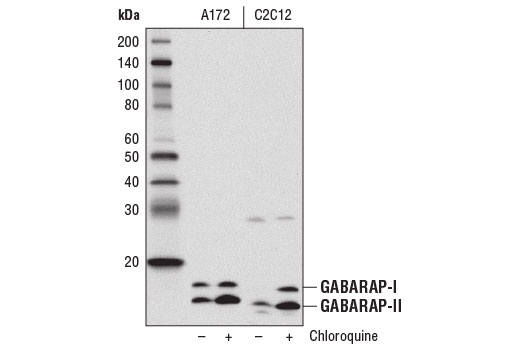
Western blot analysis of A172 and C2C12 cells, untreated (-) or chloroquine-treated (50 μM, overnight; +), using GABARAP (E1J4E) Rabbit mAb.
undefined Image 1: Autophagy Atg8 Family Antibody Sampler Kit
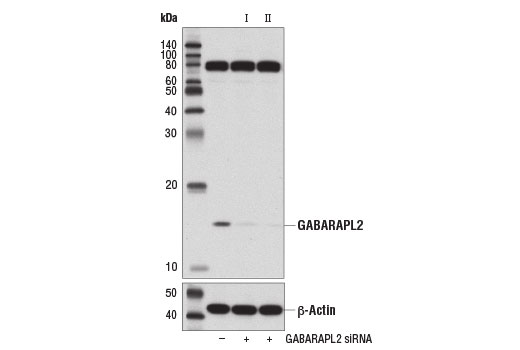
Western blot analysis of extracts from 293T cells, transfected with 100 nM SignalSilence® Control siRNA (Unconjugated) #6568 (-), SignalSilence® GABARAPL2 siRNA I # 14239 (+) or SignalSilence® II GABARAPL2 siRNA II #14246 (+), using GABARAPL2 (D1W9T) Rabbit mAb (upper) or β-Actin (D6A8) Rabbit mAb #8457 (lower). The GABARAPL2 (D1W9T) Rabbit mAb confirms silencing of GABARAPL2, while the β-Actin (D6A8) Rabbit mAb is used as a loading control.
undefined Image 2: Autophagy Atg8 Family Antibody Sampler Kit
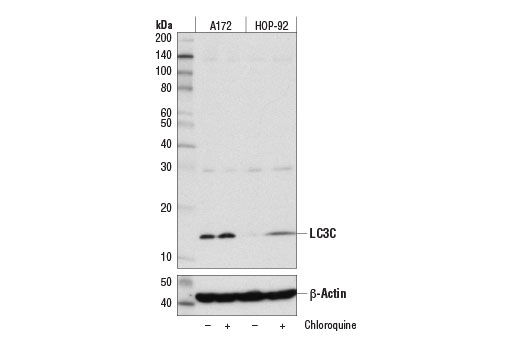
Western blot analysis of extracts from A172 and HOP-92 cells, untreated (-) or chloroquine-treated (50 μM, overnight; +), using LC3C (D3O6P) Rabbit mAb (upper) and β-Actin (D6A8) Rabbit mAb #8457 (lower).
undefined Image 3: Autophagy Atg8 Family Antibody Sampler Kit
Orders: 877-616-CELL (2355) [email protected] Support: 877-678-TECH (8324) [email protected] Web: cellsignal.com
For Research Use Only. Not for Use in Diagnostic Procedures.

Revision 1

Cell Signaling Technology Logo
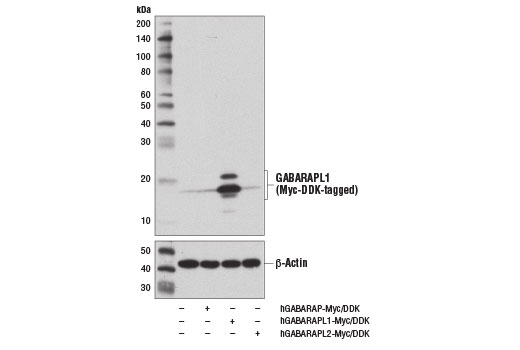
Western blot analysis of extracts from 293T cells, mock transfected (-) or transfected with constructs expressing Myc/DDK-tagged full-length human GABARAP protein (hGABARAP-Myc/DDK; +), human GABARAPL1 protein (hGABARAPL1-Myc/DDK; +), or human GABARAPL2 protein (hGABARAPL2-Myc/DDK; +) using GABARAPL1 (D5R9Y) XP® Rabbit mAb (upper) and β-Actin (D6A8) Rabbit mAb #8457 (lower).
undefined Image 4: Autophagy Atg8 Family Antibody Sampler Kit
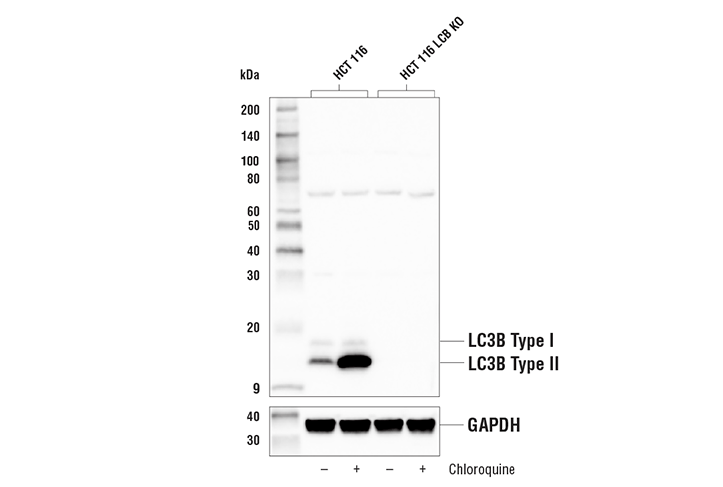
Western blot analysis of extracts from HCT 116 and HCT 116 LC3B knockout cells, untreated (-) or treated with Chloroquine #14774 (50 μM, 18 hr) using LC3B (D11) XP® Rabbit mAb #3868 (upper) or GAPDH (D16H11) XP® Rabbit mAb #5174 (lower). The absence of signal in the HCT 116 knockout cells confirms the specificity of the antibody for LC3B.
undefined Image 5: Autophagy Atg8 Family Antibody Sampler Kit
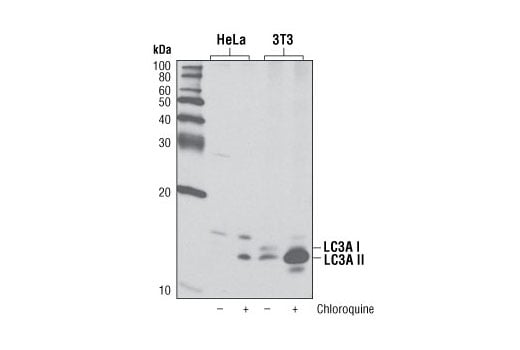
Western blot analysis of extracts from HeLa and NIH/3T3 cells, untreated or chloroquine-treated (50 μM, overnight), using LC3A (D50G8) XP® Rabbit mAb.
undefined Image 6: Autophagy Atg8 Family Antibody Sampler Kit
Orders: 877-616-CELL (2355) [email protected] Support: 877-678-TECH (8324) [email protected] Web: cellsignal.com
For Research Use Only. Not for Use in Diagnostic Procedures.

Revision 1

Cell Signaling Technology Logo
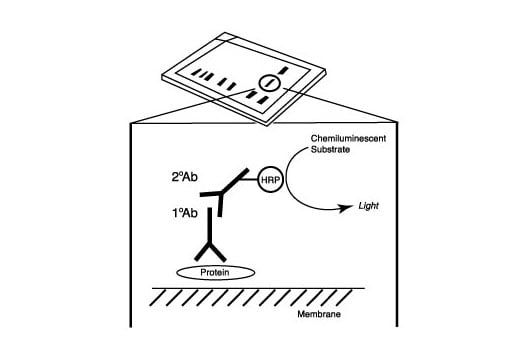
After the primary antibody is bound to the target protein, a complex with HRP-linked secondary antibody is formed. The LumiGLO® is added and emits light during enzyme catalyzed decomposition.
undefined Image 7: Autophagy Atg8 Family Antibody Sampler Kit
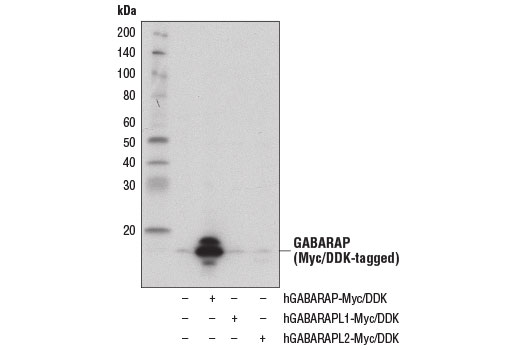
Western blot analysis of extracts from 293T cells, mock transfected (-) or transfected with constructs expressing Myc/DDK-tagged full-length human GABARAP (hGABARAP-Myc/DDK; +), human GABARAPL1 (hGABARAPL1-Myc/DDK; +), or human GABARAPL2 (hGABARAPL2-Myc/DDK; +), using GABARAP (E1J4E) Rabbit mAb.
undefined Image 8: Autophagy Atg8 Family Antibody Sampler Kit
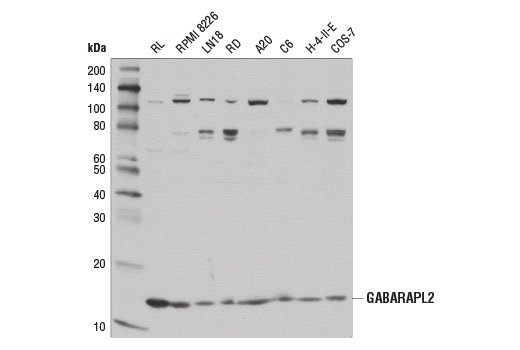
Western blot analysis of extracts from various cell lines using GABARAPL2 (D1W9T) Rabbit mAb.
undefined Image 9: Autophagy Atg8 Family Antibody Sampler Kit
Orders: 877-616-CELL (2355) [email protected] Support: 877-678-TECH (8324) [email protected] Web: cellsignal.com
For Research Use Only. Not for Use in Diagnostic Procedures.

Revision 1

Cell Signaling Technology Logo
Western blot analysis of extracts from 293T cells, mock transfected (-) or transfected with constructs expressing full-length human LC3A protein (hLC3A; +), human LC3B protein (hLC3B; +), or human LC3C protein (hLC3C; +), using LC3C (D3O6P) Rabbit mAb.
undefined Image 10: Autophagy Atg8 Family Antibody Sampler Kit
Western blot analysis of extracts from HeLa, C2C12, and C6 cells, untreated (-) or treated with chloroquine (50 μM, overnight; +), using GABARAPL1 (D5R9Y) XP® Rabbit mAb (upper) and β-Actin (D6A8) Rabbit mAb #8457 (lower).
undefined Image 11: Autophagy Atg8 Family Antibody Sampler Kit
Western blot analysis of extracts from HeLa cells, transfected with 100 nM SignalSilence® Control siRNA (Unconjugated) #6568 (-), SignalSilence® LC3B siRNA I #6212 (+) or SignalSilence® LC3B siRNA II #6213 (+), using LC3B (D11) XP® Rabbit mAb #3868 and α-Tubulin (11H10) Rabbit mAb #2125. The LC3B (D11) XP® Rabbit mAb confirms silencing of LC3B expression, while the α-Tubulin (11H10) Rabbit mAb is used to control for loading and specificity of LC3B siRNA.
undefined Image 12: Autophagy Atg8 Family Antibody Sampler Kit
Orders: 877-616-CELL (2355) [email protected] Support: 877-678-TECH (8324) [email protected] Web: cellsignal.com
For Research Use Only. Not for Use in Diagnostic Procedures.

Revision 1

Cell Signaling Technology Logo
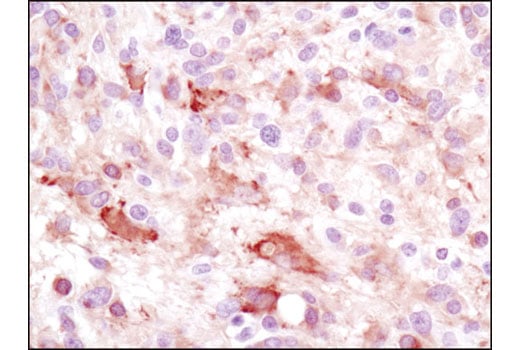
Immunohistochemical analysis of paraffin-embedded human glioblastoma multiforme using LC3A (D50G8) XP® Rabbit mAb.
undefined Image 13: Autophagy Atg8 Family Antibody Sampler Kit
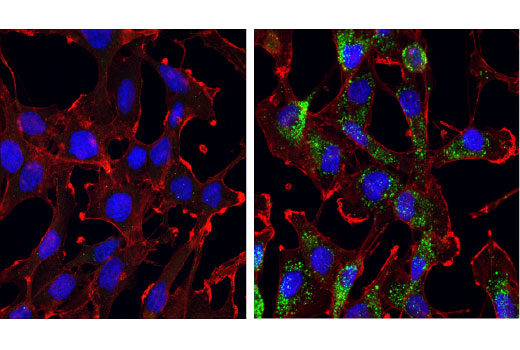
Confocal immunofluorescent analysis of A172 cells, untreated (left) and chloroquine-treated (50 μM, overnight; right), using GABARAP (E1J4E) Rabbit mAb (green) and β-Actin (8H10D10) Mouse mAb #3700 (red). Blue pseudocolor = DRAQ5® #4084 (fluorescent DNA dye).
undefined Image 14: Autophagy Atg8 Family Antibody Sampler Kit
Western blot analysis of extracts from 293T cells, mock transfected (-) or transfected with constructs expressing Myc/DDK-tagged full-length human GABARAP (hGABARAP-Myc/DDK; +), human GABARAPL1 (hGABARAPL1-Myc/DDK; +), or human GABARAPL2 (hGABARAPL2-Myc/DDK; +), using GABARAPL2 (D1W9T) Rabbit mAb.
undefined Image 15: Autophagy Atg8 Family Antibody Sampler Kit
Orders: 877-616-CELL (2355) [email protected] Support: 877-678-TECH (8324) [email protected] Web: cellsignal.com
For Research Use Only. Not for Use in Diagnostic Procedures.

Revision 1

Cell Signaling Technology Logo
Confocal immunofluorescent analysis of HeLa cells, untreated (left) or treated with chloroquine (50 μM, 24 hr; right), using GABARAPL1 (D5R9Y) XP® Rabbit mAb (green) and β-Actin (8H10D10) Mouse mAb #3700 (red). Blue pseudocolor = DRAQ5® #4084 (fluorescent DNA dye).
undefined Image 16: Autophagy Atg8 Family Antibody Sampler Kit
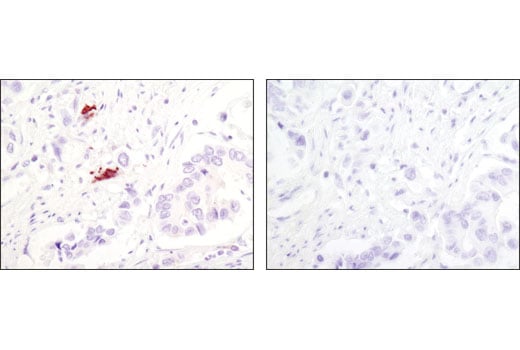
Immunohistochemical analysis of paraffin-embedded human colon carcinoma using LC3A (D50G8) XP® Rabbit mAb (left) or

Rabbit (DA1E) mAb IgG XP® Isotype Control #3900 (right).
undefined Image 17: Autophagy Atg8 Family Antibody Sampler Kit
Western blot analysis of extracts from A172 and HeLa cells, untreated (-) or treated overnight with chloroquine (50 μM) (+), using GABARAPL2 (D1W9T) Rabbit mAb (upper) or β-Actin (D6A8) #8457 (lower).
undefined Image 18: Autophagy Atg8 Family Antibody Sampler Kit
Orders: 877-616-CELL (2355) [email protected] Support: 877-678-TECH (8324) [email protected] Web: cellsignal.com
For Research Use Only. Not for Use in Diagnostic Procedures.

Revision 1

Cell Signaling Technology Logo
Immunohistochemical analysis of paraffin-embedded HeLa cell pellets, control (left) or choloroquine-treated (right), using LC3A (D50G8) XP® Rabbit mAb.
undefined Image 19: Autophagy Atg8 Family Antibody Sampler Kit
Confocal immunofluorescent analysis of HCT 116 cells either untreated (left) or treated with Chloroquine #14774 (50 µM, overnight) (center) or LC3B HCT 116 knockout cells treated with Chloroquine #14774 (50 µM, overnight) (right) using LC3B (D11) XP® Rabbit mAb (green). Actin filaments were labeled with β-Actin (8H10D10) Mouse mAb (red) and nuclei were labeled with DAPI #4083 (blue).
undefined Image 20: Autophagy Atg8 Family Antibody Sampler Kit
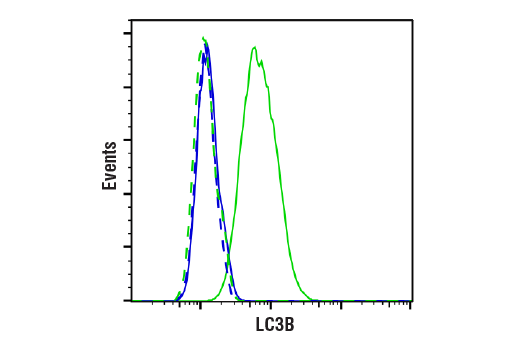
Flow cytometric analysis of HCT-116 cells, wild-type (green, high expression) or LC3B knockdown (blue, negative expression), using LC3B (D11) XP® Rabbit mAb #3868 (solid lines) or a concentration-matched Rabbit (DA1E) mAb IgG XP® Isotype Control #3900 (dashed lines). Anti-rabbit IgG (H+L), F(ab')2 Fragment (Alexa Fluor® 488 Conjugate) #4412 was used as a secondary antibody.
undefined Image 21: Autophagy Atg8 Family Antibody Sampler Kit
Orders: 877-616-CELL (2355) [email protected] Support: 877-678-TECH (8324) [email protected] Web: cellsignal.com
For Research Use Only. Not for Use in Diagnostic Procedures.

Revision 1

Cell Signaling Technology Logo
Flow cytometric analysis of fixed/permeabilized MCF7 cells (blue, negative) and A-498 cells (green, positive) using GABARAPL1 (D5R9Y) Rabbit mAb (solid lines) or a concentration matched Rabbit (DA1E) mAb IgG XP® Isotype Control #3900 (dashed lines). Anti-rabbit IgG (H+L), F(ab')2 Fragment (Alexa Fluor® 488 Conjugate) #4412 was used as a secondary antibody.
undefined Image 22: Autophagy Atg8 Family Antibody Sampler Kit
Orders: 877-616-CELL (2355) [email protected] Support: 877-678-TECH (8324) [email protected] Web: cellsignal.com
For Research Use Only. Not for Use in Diagnostic Procedures.