Revision 1

#14541

Store at -20C

T Cell Signaling Antibody Sampler Kit

1 Kit

(8 x 20 microliters)

CST Logo
Orders:

877-616-CELL (2355)

[email protected]

Support:

877-678-TECH (8324)

3 Trask Lane | Danvers | Massachusetts | 01923 | USA

For Research Use Only. Not for Use in Diagnostic Procedures.

Product Includes Product # Quantity Mol. Wt Isotype/Source
CD3 epsilon (CD3-12) Rat Monoclonal Antibody444320 µl21 kDaRat IgG1
Phospho-LAT (Tyr220) Antibody358420 µl36, 38 kDaRabbit
Phospho-Lck (Tyr505) Antibody275120 µl56 kDaRabbit
Phospho-PLC gamma1 (Tyr783) (D6M9S) Rabbit Monoclonal Antibody1400820 µl155 kDaRabbit IgG
Phospho-Src Family (Tyr416) (D49G4) Rabbit Monoclonal Antibody694320 µl60 kDaRabbit IgG
Phospho-SLP-76 (Ser376) (D9D6E) Rabbit Monoclonal Antibody1474520 µl76 kDaRabbit IgG
Phospho-Zap-70 (Tyr319)/Syk (Tyr352) (65E4) Rabbit Monoclonal Antibody271720 µl70, 72 kDaRabbit IgG
Phospho-Zap-70 (Tyr493)/Syk (Tyr526) Antibody270420 µl70 kDaRabbit
Anti-rat IgG, HRP-linked Antibody7077100 µlGoat
Anti-rabbit IgG, HRP-linked Antibody7074100 µlGoat

Please visit cellsignal.com for individual component applications, species cross-reactivity, dilutions, protocols, and additional product information.

Description

The T Cell Signaling Antibody Sampler Kit provides an economical means to investigate T cell receptor signaling. The kit contains primary and secondary antibodies to perform two western blot experiments per primary antibody.

Storage

Supplied in 10 mM sodium HEPES (pH 7.5), 150 mM NaCl, 100 µg/ml BSA, 50% glycerol and less than 0.02% sodium azide. Store at –20°C. Do not aliquot the antibody.

Background

When T cells encounter antigens via the T cell receptor (TCR), information about the quantity and quality of antigens is relayed to the intracellular signal transduction machinery (1). This activation process depends mainly on CD3 (Cluster of Differentiation 3), a multiunit protein complex that directly associates with the TCR α and ß chains. CD3 is composed of four polypeptides: ζ, γ, ε and δ. Each of these polypeptides contains at least one immunoreceptor tyrosine-based activation motif (ITAM) (2). The Src family kinases Lck and Fyn are recruited to the TCR complex upon stimulation and activate the downstream tyrosine kinases to initiate signaling. Phosphorylation of Lck at Tyr394 leads to an increase in Lck activity while phosphorylation of Tyr505 in the Lck carboxy-terminal tail down-regulates Lck catalytic activity (3). Zap-70 and Syk are rapidly phosphorylated on several tyrosine residues through autophosphorylation and transphosphorylation by Src family tyrosine kinases.  Activation loop phosphorylation of Zap-70 at Tyr493 and Syk at Tyr526 leads to complete activation of both kinases (4).  Subsequent phosphorylation of other tyrosine residues within the kinase interdomain B region, including Zap-70 at Tyr315 and Zap-70 at Tyr 319, create docking sites for downstream signaling molecules.  Zap-70 and Syk phosphorylate the transmembrane adaptor protein LAT at multiple, conserved tyrosine residues within SH2 binding motifs, exposing these motifs as docking sites for downstream signaling targets (5,6). The phosphorylation of LAT at Tyr171 and Tyr220 enables the binding of Grb2, Gads/SLP-76, PLCγ1, and PI3 kinase. The adapter protein SLP-76 is phosphorylated at Tyr113 and Tyr128, allowing for binding of the Grb2-like adapter Gads.  Phosphorylation of SLP-76 at Ser376 by hematopoietic progenitor kinase 1 (HPK1) induces interaction with 14-3-3ε and down-regulates TCR signaling (7,8).  Phosphoinositide-specific phospholipase PLCγ1 enzyme activity is also stimulated by Zap-70 and Syk phosphorylation on Tyr783, Tyr711, and Tyr1253, resulting in robust PI-4,5-P2 hydrolysis (9).

Trademarks and Patents

Cell Signaling Technology is a trademark of Cell Signaling Technology, Inc.

All other trademarks are the property of their respective owners. Visit cellsignal.com/trademarks for more information.

Limited Uses

Except as otherwise expressly agreed in a writing signed by a legally authorized representative of CST, the following terms apply to Products provided by CST, its affiliates or its distributors. Any Customer's terms and conditions that are in addition to, or different from, those contained herein, unless separately accepted in writing by a legally authorized representative of CST, are rejected and are of no force or effect.

Products are labeled with For Research Use Only or a similar labeling statement and have not been approved, cleared, or licensed by the FDA or other regulatory foreign or domestic entity, for any purpose. Customer shall not use any Product for any diagnostic or therapeutic purpose, or otherwise in any manner that conflicts with its labeling statement. Products sold or licensed by CST are provided for Customer as the end-user and solely for research and development uses. Any use of Product for diagnostic, prophylactic or therapeutic purposes, or any purchase of Product for resale (alone or as a component) or other commercial purpose, requires a separate license from CST. Customer shall (a) not sell, license, loan, donate or otherwise transfer or make available any Product to any third party, whether alone or in combination with other materials, or use the Products to manufacture any commercial products, (b) not copy, modify, reverse engineer, decompile, disassemble or otherwise attempt to discover the underlying structure or technology of the Products, or use the Products for the purpose of developing any products or services that would compete with CST products or services, (c) not alter or remove from the Products any trademarks, trade names, logos, patent or copyright notices or markings, (d) use the Products solely in accordance with CST Product Terms of Sale and any applicable documentation, and (e) comply with any license, terms of service or similar agreement with respect to any third party products or services used by Customer in connection with the Products.

Orders: 877-616-CELL (2355) [email protected] Support: 877-678-TECH (8324) [email protected] Web: cellsignal.com
For Research Use Only. Not for Use in Diagnostic Procedures.

Revision 1

Cell Signaling Technology Logo
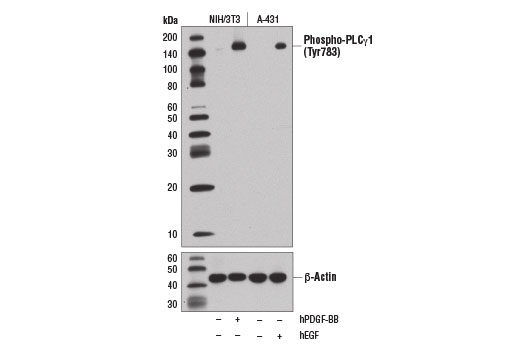
Western blot analysis of extracts from NIH/3T3 cells, untreated (-) or stimulated with hPDGF-BB #8912 (5 min; +), and from A-431 cells, untreated (-) or stimulated with hEGF #8916 (5 min; +), using Phospho-PLCγ1 (Tyr783) (D6M9S) Rabbit mAb (upper) and β-Actin (D6A8) Rabbit mAb #8457 (lower).
undefined Image 1: T Cell Signaling Antibody Sampler Kit
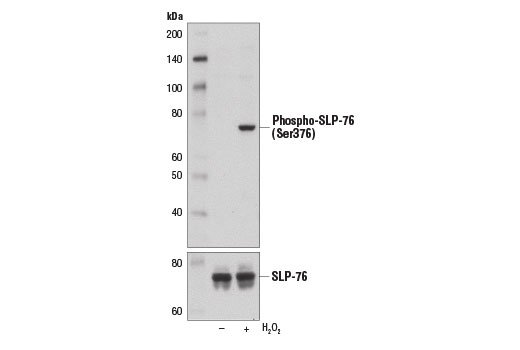
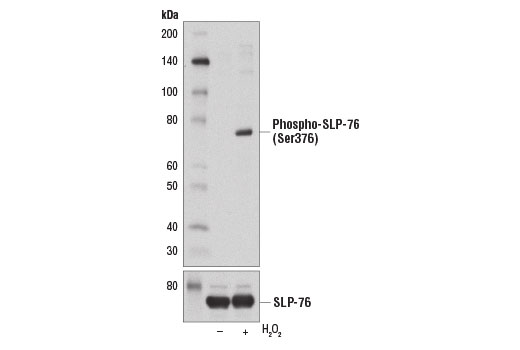
Western blot analysis of extracts from Jurkat cells, untreated (-) or treated with H2O2 (11 mM, 1 min; +), using Phospho-SLP-76 (Ser376) (D9D6E) Rabbit mAb (upper) or SLP-76 Antibody #4958 (lower).
undefined Image 2: T Cell Signaling Antibody Sampler Kit
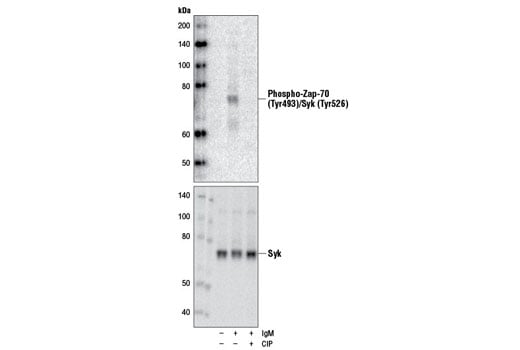
Western blot analysis of extracts from Ramos cells untreated or treated with 10 µg/ml IgM for 2 minutes with or without calf intestinal phosphatase (CIP), using Phospho-Zap-70 (Tyr493)/Syk (Tyr526) Antibody (upper) or Syk Antibody #12358 (lower).
undefined Image 3: T Cell Signaling Antibody Sampler Kit
Orders: 877-616-CELL (2355) [email protected] Support: 877-678-TECH (8324) [email protected] Web: cellsignal.com
For Research Use Only. Not for Use in Diagnostic Procedures.

Revision 1

Cell Signaling Technology Logo
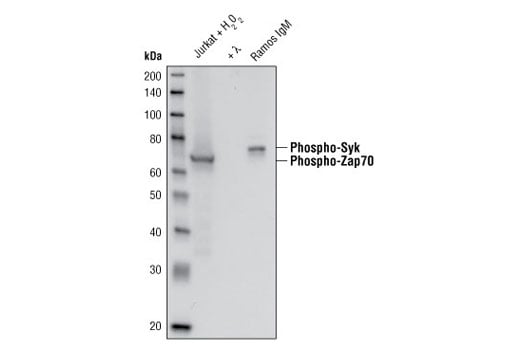
Western blot analysis of extracts from Jurkat cells treated with hydrogen peroxide (2mM for 2 minutes) or with lambda phosphatase and extracts from Ramos cells treated with anti-human IgM (12 micrograms/ml for 2 minutes) using Phospho-Zap-70 (Tyr319)/Syk (Tyr352) (65E4) Rabbit mAb.
undefined Image 4: T Cell Signaling Antibody Sampler Kit
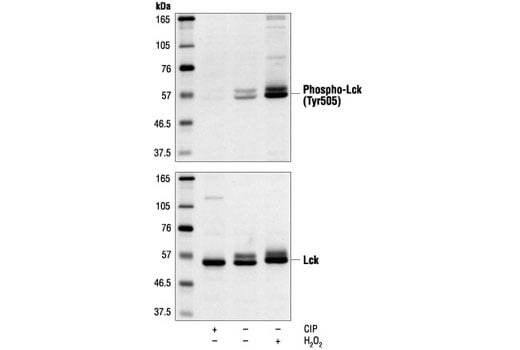
Western blot analysis of extracts from Jurkat cells (starved for 16 hours) treated with calf intestinal alkaline phosphatase (CIP) or H2O2 (2 mM), using Phospho-Lck (Tyr505) Antibody (upper) or control Lck Antibody #2752 (lower).
undefined Image 5: T Cell Signaling Antibody Sampler Kit
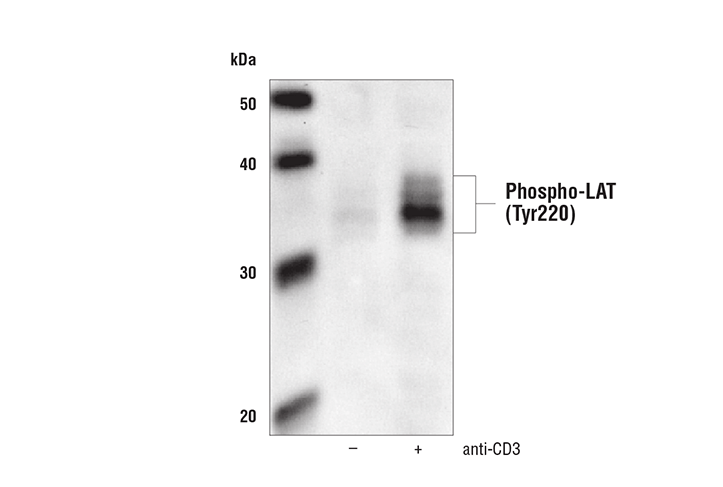
Western blot analysis of SDS extracts from untreated or anti-CD3 treated (10 µg/ml for 2 minutes) human Jurkat cells after overnight serum starvation using Phospho-LAT (Tyr220) Antibody.
undefined Image 6: T Cell Signaling Antibody Sampler Kit
Orders: 877-616-CELL (2355) [email protected] Support: 877-678-TECH (8324) [email protected] Web: cellsignal.com
For Research Use Only. Not for Use in Diagnostic Procedures.

Revision 1

Cell Signaling Technology Logo
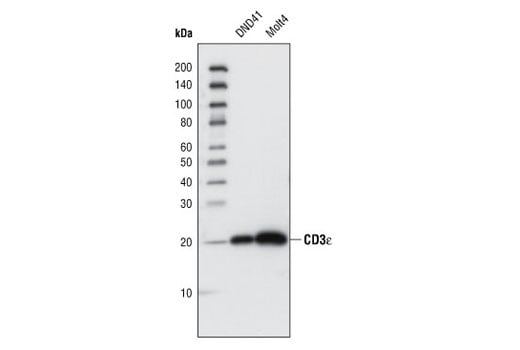
Western blot analysis of total cell lysates from DND41 and Molt4 cells using CD3ε (CD3-12) Rat mAb.
undefined Image 7: T Cell Signaling Antibody Sampler Kit
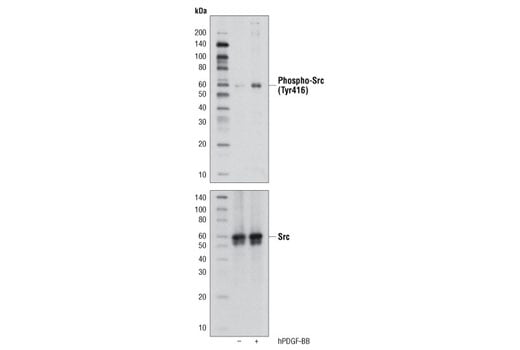
Western blot analysis of extracts NIH/3T3 cells, serum-starved or treated with human Platelet-Derived Growth Factor BB hPDGF-BB (100 ng/ml, 15 min), using Phospho-Src Family (Tyr416) (D49G4) Rabbit mAb (upper) or Src (36D10) Rabbit mAb #2109 (lower).
undefined Image 8: T Cell Signaling Antibody Sampler Kit
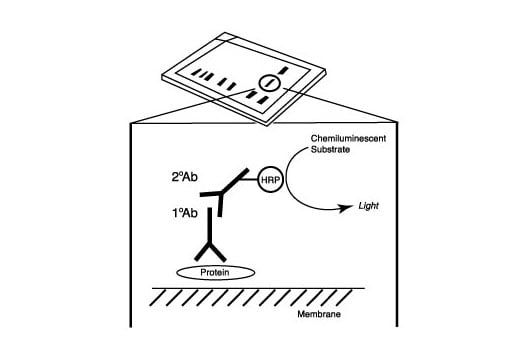
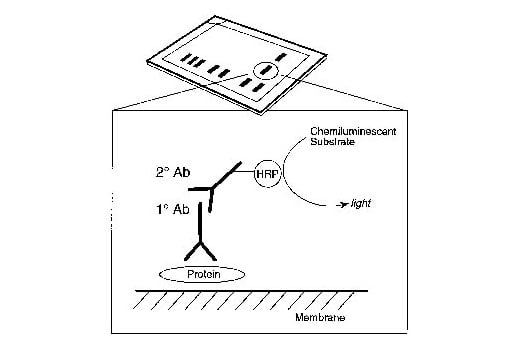
After the primary antibody is bound to the target protein, a complex with HRP-linked secondary antibody is formed. The LumiGLO® is added and emits light during enzyme catalyzed decomposition.
undefined Image 9: T Cell Signaling Antibody Sampler Kit
Orders: 877-616-CELL (2355) [email protected] Support: 877-678-TECH (8324) [email protected] Web: cellsignal.com
For Research Use Only. Not for Use in Diagnostic Procedures.

Revision 1

Cell Signaling Technology Logo
After the primary antibody is bound to the target protein, a complex with HRP-linked secondary antibody is formed. The LumiGlo® is added and emits light during enzyme catalyzed decomposition.
undefined Image 10: T Cell Signaling Antibody Sampler Kit
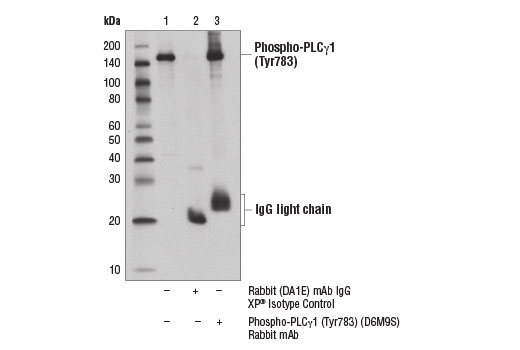
Immunoprecipitation of phospho-PLCγ1 (Tyr783) from A-431 cell extracts stimulated with hEGF #8916 using Rabbit (DA1E) mAb IgG XP® Isotype Control #3900 (lane 2) or Phospho-PLCγ1 (Tyr783) (D6M9S) Rabbit mAb (lane 3). Lane 1 is 10% input. Western blot analysis was performed using Phospho-PLCγ1 (Tyr783) (D6M9S) Rabbit mAb.
undefined Image 11: T Cell Signaling Antibody Sampler Kit
Western blot analysis of extracts from EL4 cells, untreated (-) or treated with H2O2 (11 mM, 1 min; +), using Phospho-SLP-76 (Ser376) (D9D6E) Rabbit mAb (upper) or SLP-76 Antibody #4958 (lower).
undefined Image 12: T Cell Signaling Antibody Sampler Kit
Orders: 877-616-CELL (2355) [email protected] Support: 877-678-TECH (8324) [email protected] Web: cellsignal.com
For Research Use Only. Not for Use in Diagnostic Procedures.

Revision 1

Cell Signaling Technology Logo
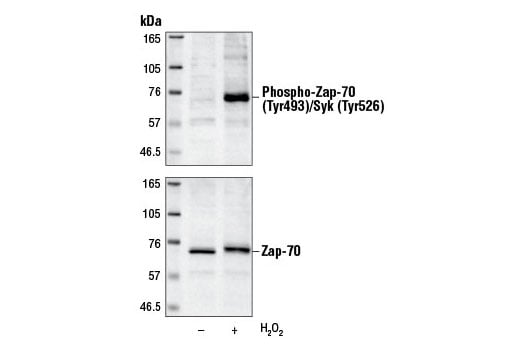
Western blot analysis of extracts from Jurkat cells starved for 16 hours and treated with 2 mM H2O2 for 3 minutes, using Phospho-Zap-70 (Tyr493)/Syk (Tyr526) Antibody (upper) or control Zap-70 Antibody #2702 (lower).
undefined Image 13: T Cell Signaling Antibody Sampler Kit
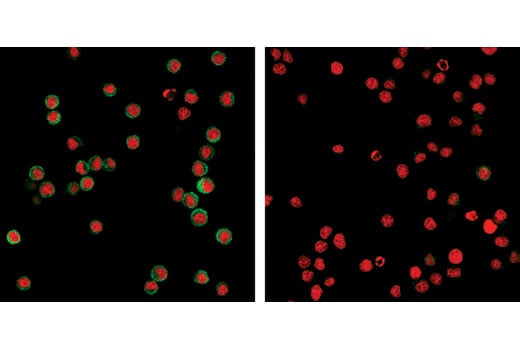
Confocal immunofluorescent analysis of Ramos cells, human IgM treated (left) or untreated (right), using Phospho-Zap-70 (Tyr319)/Syk (Tyr352) (65E4) Rabbit mAb (green). Red = Propidium Iodide (PI)/RNase Staining Solution #4087.
undefined Image 14: T Cell Signaling Antibody Sampler Kit
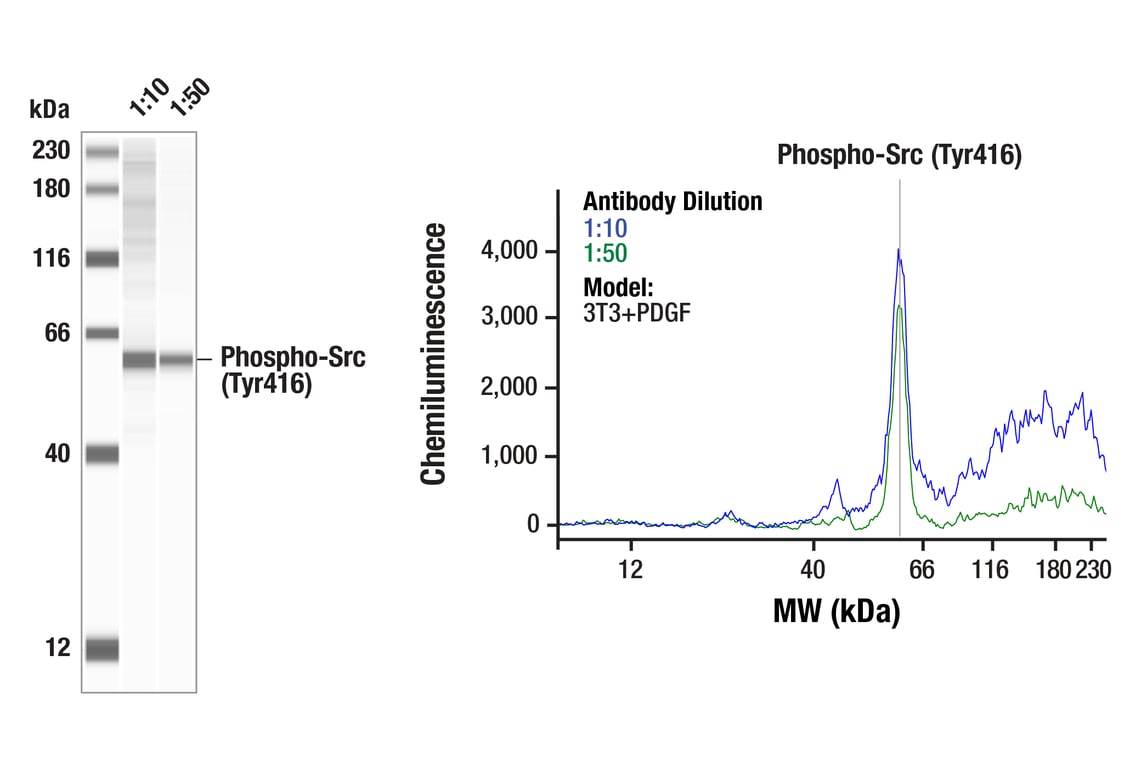
Simple Western™ analysis of lysates (1 mg/mL) from 3T3+PDGF cells using Phospho-Src Family (Tyr416) (D49G4) Rabbit mAb #6943. The virtual lane view (left) shows the target band (as indicated) at 1:10 and 1:50 dilutions of primary antibody. The corresponding electropherogram view (right) plots chemiluminescence by molecular weight along the capillary at 1:10 (blue line) and 1:50 (green line) dilutions of primary antibody. This experiment was performed under reducing conditions on the Jess™ Simple Western instrument from ProteinSimple, a BioTechne brand, using the 12-230 kDa separation module.
undefined Image 15: T Cell Signaling Antibody Sampler Kit
Orders: 877-616-CELL (2355) [email protected] Support: 877-678-TECH (8324) [email protected] Web: cellsignal.com
For Research Use Only. Not for Use in Diagnostic Procedures.

Revision 1

Cell Signaling Technology Logo
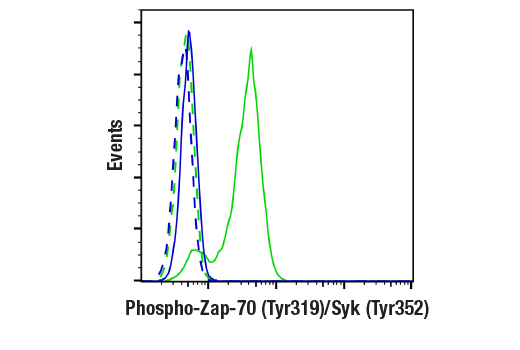
Flow cytometric analysis of Ramos cells, untreated (blue) or treated with anti-IgM (12 µg/mL, 2 min; green), using Phospho-Zap-70 (Tyr319)/Syk (Tyr352) (65E4) Rabbit mAb (solid lines) or concentration-matched Rabbit (DA1E) mAb IgG XP® Isotype Control #3900 (dashed lines). Anti-rabbit IgG (H+L), F(ab')2 Fragment (Alexa Fluor® 488 Conjugate) #4412 was used as a secondary antibody.
undefined Image 16: T Cell Signaling Antibody Sampler Kit
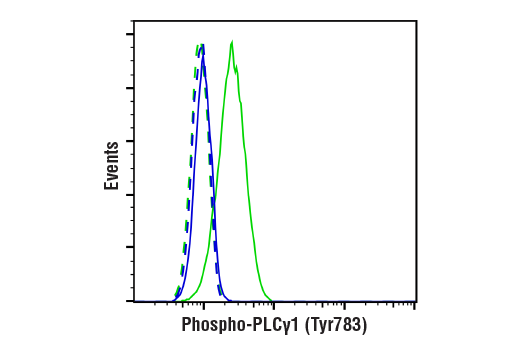
Flow cytometric analysis of NIH/3T3 cells, untreated (blue) or treated with mPDGFbb (200ng/mL, 15 min; green) using Phospho-PLCγ1 (Tyr783) (D6M9S) Rabbit mAb (solid lines) or concentration-matched Rabbit (DA1E) mAb IgG XP® Isotype Control #3900 (dashed lines). Anti-rabbit IgG (H+L), F(ab')2 Fragment (Alexa Fluor® 488 Conjugate) #4412 was used as a secondary antibody.
undefined Image 17: T Cell Signaling Antibody Sampler Kit
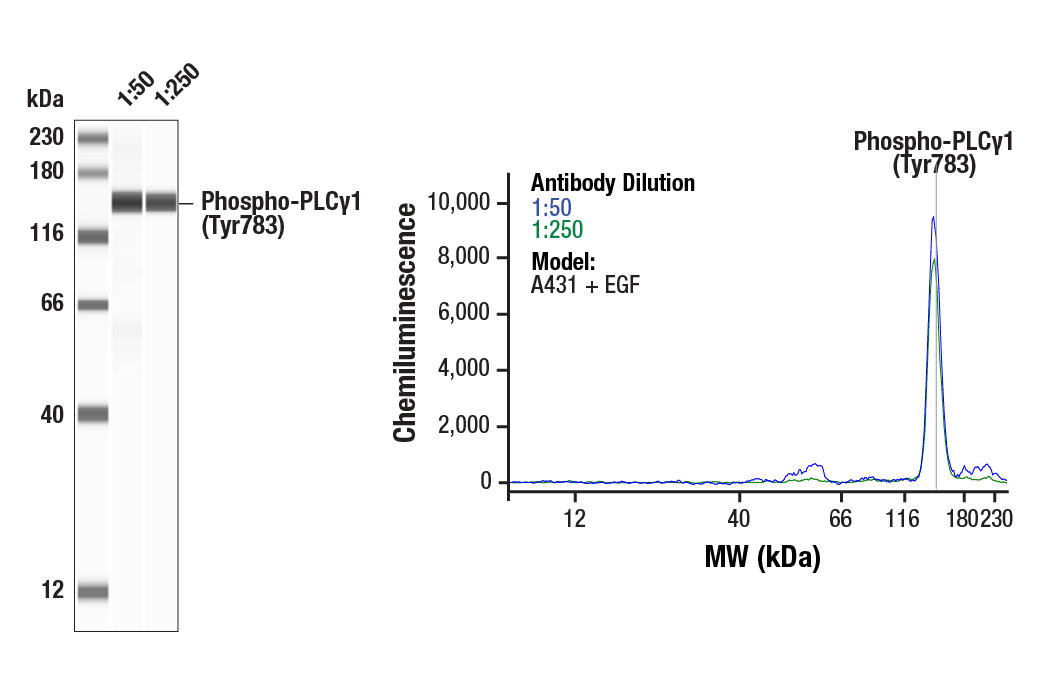
Simple Western™ analysis of lysates (0.1 mg/mL) from serum-starved A431 cells treated with hEGF (100 ng/mL, 5 min.) using Phospho-PLCγ1 (Tyr783) (D6M9S) Rabbit mAb #14008. The virtual lane view (left) shows a single target band (as indicated) at 1:50 and 1:250 dilutions of primary antibody. The corresponding electropherogram view (right) plots chemiluminescence by molecular weight along the capillary at 1:50 (blue line) and 1:250 (green line) dilutions of primary antibody. This experiment was performed under reducing conditions on the Jess™ Simple Western instrument from ProteinSimple, a BioTechne brand, using the 12-230 kDa separation module.
undefined Image 18: T Cell Signaling Antibody Sampler Kit
Orders: 877-616-CELL (2355) [email protected] Support: 877-678-TECH (8324) [email protected] Web: cellsignal.com
For Research Use Only. Not for Use in Diagnostic Procedures.