Revision 1
#5523
Store at -20C

877-616-CELL (2355)
877-678-TECH (8324)
3 Trask Lane | Danvers | Massachusetts | 01923 | USA
For Research Use Only. Not for Use in Diagnostic Procedures.
Applications:
W
Reactivity:
H M R Mk
Sensitivity:
Endogenous
MW (kDa):
79
Source/Isotype:
Rabbit IgG
UniProt ID:
#Q9BY84
Entrez-Gene Id:
80824
Product Usage Information
| Application | Dilution |
|---|---|
| Western Blotting | 1:1000 |
Storage
Specificity/Sensitivity
Species predicted to react based on 100% sequence homology
Source / Purification
Background
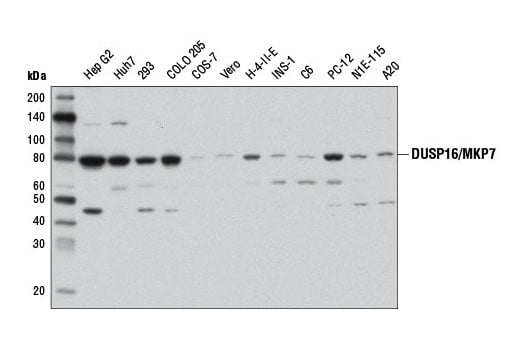
DUSP16/MKP7 is a negative regulator of the JNK/SAPK family of stress-activated MAP kinases. It inhibits JNK-mediated signaling events by dephosphorylating threonine and tyrosine residues within the activation loop of JNK proteins, effectively preventing further activation of downstream effectors (7,8). DUSP16/MKP7 expression has been shown to be upregulated after oxidative stress, presumably as a means of supressing JNK activity in order to return the cells to a homeostatic state (9). DUSP16 is normally turned over at a high-rate in most cells, but the stability of the protein can be enhanced by Erk1/2-mediated phosphorylation on Ser446, indicating that activation of mitogenic signaling pathways can supress stress-response pathways via stabilization of a JNK phosphatase (10,11). Despite demonstrating a substrate preference towards JNK proteins, DUSP16/MKP7 has been shown to interact with other MAPK family members (Erk1/2, p38 MAPKs) as well as scaffolding proteins that may coordinate its activity and specificity (12,13).
DUSP16 is epigenetically silenced in Burkitt's lymphoma by increased methylation of the 5' regulatory regions of the gene (14). Methylation of the DUSP16 gene and expression of DUSP16 protein inversely correlate with increased basal levels of JNK acitvitiy, suggesting DUSP16/MKP7 may play a critical role in maintaining JNK signaling in an "off" state in normal cells (14). More recently, DUSP16/MKP7 has been shown to play a crucial role in T helper (Th) cell differentiation into Th1 and Th2 cells, mediated by JNK signaling pathways (15). DUSP16/MKP7 expression is preferentially high in Th2 cells and low in Th1 cells during differentiation, resulting in either low (Th2) or high (Th1) JNK activity. This suggests that DUSP16 expression may be a regulator of Th cell balance (15).
Background References
- Camps, M. et al. (2000) FASEB J 14, 6-16.
- Theodosiou, A. and Ashworth, A. (2002) Genome Biol 3, REVIEWS3009.
- Salojin, K. and Oravecz, T. (2007) J Leukoc Biol 81, 860-9.
- Tanoue, T. et al. (2002) J Biol Chem 277, 22942-9.
- Dickinson, R.J. and Keyse, S.M. (2006) J Cell Sci 119, 4607-15.
- Wu, G.S. (2007) Cancer Metastasis Rev 26, 579-85.
- Matsuguchi, T. et al. (2001) Mol Cell Biol 21, 6999-7009.
- Masuda, K. et al. (2001) J Biol Chem 276, 39002-11.
- Teng, C.H. et al. (2007) J Biol Chem 282, 28395-407.
- Katagiri, C. et al. (2005) J Biol Chem 280, 14716-22.
- Masuda, K. et al. (2003) J Biol Chem 278, 32448-56.
- Willoughby, E.A. and Collins, M.K. (2005) J Biol Chem 280, 25651-8.
- Willoughby, E.A. et al. (2003) J Biol Chem 278, 10731-6.
- Lee, S. et al. (2010) Br J Cancer 103, 265-74.
- Musikacharoen, T. et al. (2011) J Biol Chem 286, 24896-905.
Species Reactivity
Species reactivity is determined by testing in at least one approved application (e.g., western blot).
Western Blot Buffer
IMPORTANT: For western blots, incubate membrane with diluted primary antibody in 5% w/v BSA, 1X TBS, 0.1% Tween® 20 at 4°C with gentle shaking, overnight.
Applications Key
W: Western Blotting
Cross-Reactivity Key
H: Human M: Mouse R: Rat Mk: Monkey
Trademarks and Patents
Cell Signaling Technology is a trademark of Cell Signaling Technology, Inc.
All other trademarks are the property of their respective owners. Visit cellsignal.com/trademarks for more information.
Limited Uses
Except as otherwise expressly agreed in a writing signed by a legally authorized representative of CST, the following terms apply to Products provided by CST, its affiliates or its distributors. Any Customer's terms and conditions that are in addition to, or different from, those contained herein, unless separately accepted in writing by a legally authorized representative of CST, are rejected and are of no force or effect.
Products are labeled with For Research Use Only or a similar labeling statement and have not been approved, cleared, or licensed by the FDA or other regulatory foreign or domestic entity, for any purpose. Customer shall not use any Product for any diagnostic or therapeutic purpose, or otherwise in any manner that conflicts with its labeling statement. Products sold or licensed by CST are provided for Customer as the end-user and solely for research and development uses. Any use of Product for diagnostic, prophylactic or therapeutic purposes, or any purchase of Product for resale (alone or as a component) or other commercial purpose, requires a separate license from CST. Customer shall (a) not sell, license, loan, donate or otherwise transfer or make available any Product to any third party, whether alone or in combination with other materials, or use the Products to manufacture any commercial products, (b) not copy, modify, reverse engineer, decompile, disassemble or otherwise attempt to discover the underlying structure or technology of the Products, or use the Products for the purpose of developing any products or services that would compete with CST products or services, (c) not alter or remove from the Products any trademarks, trade names, logos, patent or copyright notices or markings, (d) use the Products solely in accordance with CST Product Terms of Sale and any applicable documentation, and (e) comply with any license, terms of service or similar agreement with respect to any third party products or services used by Customer in connection with the Products.
Revision 1